
Introduction
PPH (Polypropylene Homopolymer) fitting unions are critical components in industrial piping systems, offering a reliable, reusable, and corrosion-resistant method for connecting PPH pipes. Unlike permanent joints like butt welding, unions allow for easy disassembly without cutting the pipe, making them ideal for maintenance-heavy applications such as chemical processing, wastewater treatment, and aquaculture. This guide covers everything from how PPH fitting unions work to their installation best practices and industry-specific use cases.
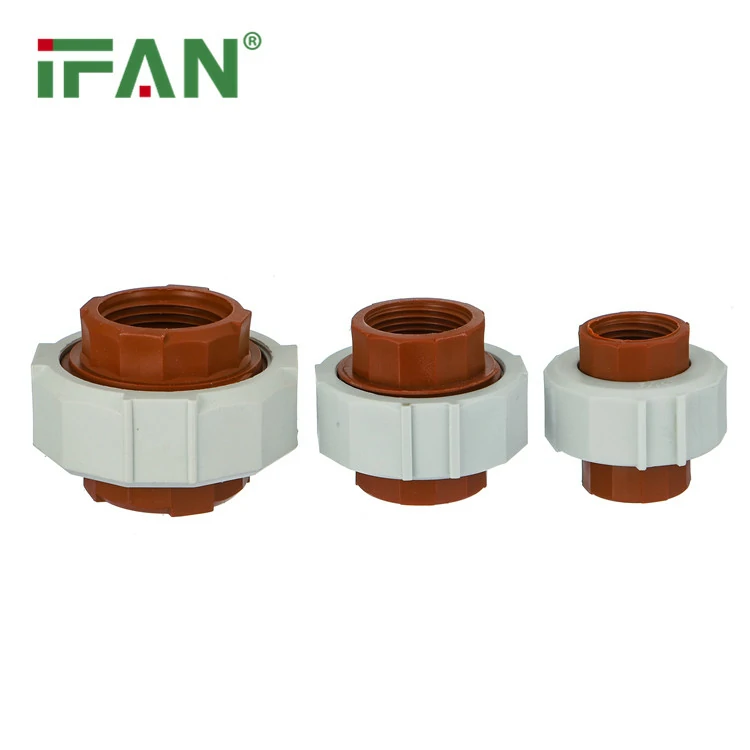
What Is a PPH Fitting Union?
A PPH fitting union is a three-piece mechanical connector designed to join two PPH pipes or fittings while allowing for future disconnection. It consists of:
- A Nut: Threaded onto the union body to apply pressure.
- A Union Body: The central piece with male threads on one end and a socket for the pipe on the other.
- A Tailpiece (or End Piece): A socketed fitting that connects to the second pipe and mates with the union body.
When tightened, the nut compresses a gasket (often made of EPDM or FPM) between the union body and tailpiece, creating a leak-proof seal.
How Do PPH Fitting Unions Work?
The assembly process involves:
- Inserting the Pipes: Slide the union body and tailpiece onto each pipe end.
- Aligning the Components: Ensure the male threads of the union body engage with the female threads of the tailpiece.
- Tightening the Nut: Use a wrench to secure the nut, compressing the gasket and forming a tight seal.
PPH fitting unions are engineered to withstand:
- High temperatures (up to 100°C/212°F).
- Aggressive chemicals (acids, alkalis, solvents).
- Pressure ratings of up to 16 bar (232 PSI), depending on the design.
Key Benefits of PPH Fitting Unions
- Reusability
Unlike welded joints, unions can be disassembled and reassembled multiple times without damaging the pipes or fittings, reducing downtime during repairs. - Chemical Resistance
PPH’s inertness to most industrial chemicals ensures long-term durability in corrosive environments, such as:- Sulfuric acid plants.
- Chlorine handling systems.
- Electroplating lines.
- Thermal Stability
PPH unions maintain their structural integrity at temperatures up to 100°C, outperforming PVC (60°C) and CPVC (95°C) in hot-water applications. - Quick Installation
No specialized welding equipment is required—just basic hand tools like wrenches and pipe cutters. - Vibration Resistance
The mechanical design absorbs minor vibrations, reducing the risk of leaks in dynamic systems like pumps or compressors.
Installation Guide for PPH Fitting Unions
- Prepare the Pipes
- Cut the pipes squarely using a pipe cutter or hacksaw.
- Deburr the edges to remove sharp fragments that could damage the gasket.
- Select the Right Gasket Material
- EPDM: For general-purpose water and mild chemicals.
- FPM (Viton): For high-temperature oils, fuels, and concentrated acids.
- Assemble the Union
- Slide the nut and union body onto one pipe end.
- Insert the tailpiece onto the other pipe.
- Align the union body and tailpiece, then hand-tighten the nut.
- Final Tightening
- Use two wrenches to hold the union body and tighten the nut an additional 1–2 turns. Avoid over-tightening, which can crush the gasket.
- Pressure Test
- After installation, pressurize the system to 1.5x the working pressure to check for leaks.
Maintenance Tips for PPH Fitting Unions
- Inspect Gaskets Regularly: Replace worn or cracked gaskets immediately.
- Avoid Over-Tightening: This can deform the union body or tailpiece.
- Lubricate Threads: Use PTFE-based lubricant on threads to prevent corrosion and ease disassembly.
- Protect from UV Light: Outdoor unions should be painted or covered to prevent degradation.
Environmental Impact of PPH Fitting Unions
PPH unions contribute to sustainability by:
- Reducing Waste: Reusable design minimizes the need for replacement fittings.
- Energy Efficiency: No welding means no energy-intensive heating processes.
- Recyclability: PPH can be recycled into new products at end-of-life.
Conclusion
PPH fitting unions are indispensable for industrial systems requiring flexibility, chemical resistance, and ease of maintenance. Their ability to withstand high temperatures and aggressive substances makes them a superior alternative to welded or glued joints in many applications. By following proper installation and maintenance practices, you can ensure decades of reliable performance while reducing operational costs.
IFAN factory started in 1993. And IFAN has workshop 120000 square meter with 610 staff. IFAN can design and produce all plumbing pipe and fitting include PPR,PVC,CPVC PPSU HDPE PEXA PEXB PERT pipe and fitting ,brass fitting, brass ball valve ,heating system , gas system , sanitary faucets and hose, In the past 30 Years, IFAN has never forgotten his mission-To protect health and safety. And IFAN factory use best materials to produce high quality pipe and fittings with automatic production line and high tech quality control machines. The most important,IFAN can guarantee that all pipes and fittings manufactured by IFAN are qualified. More information pls feel free contact us Whatsapp.