
1. Definition and Composition
PPR (Polypropylene Random Copolymer) manifolds are plumbing components designed to distribute water or other fluids efficiently across multiple outlets. Made from high-quality PPR material, they are engineered to withstand high temperatures (up to 95°C) and pressures (PN25), making them ideal for both hot and cold water systems. The material’s smooth, non-porous surface minimizes friction loss and prevents bacterial growth, ensuring hygienic water supply.
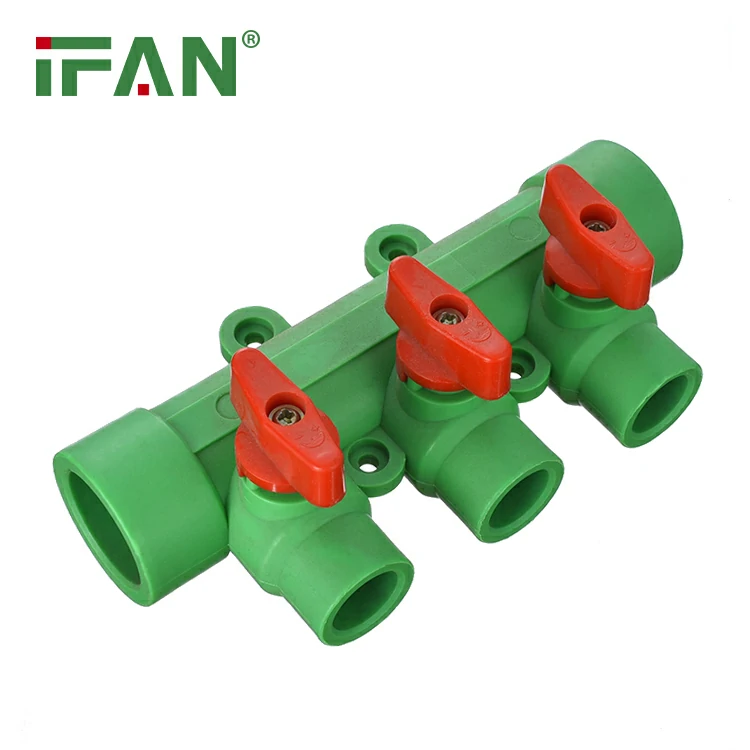
2. Key Features and Advantages
- Corrosion Resistance: Unlike metal pipes, PPR manifolds are immune to rust and chemical corrosion, extending their lifespan to over 50 years.
- Leak-Free Design: Advanced fusion welding technology creates monolithic joints, eliminating leaks and reducing maintenance costs.
- Thermal Stability: PPR can endure temperature fluctuations without deforming, making it suitable for heating systems and solar water heaters.
- Lightweight and Durable: Weighing 70% less than steel, PPR manifolds are easy to transport and install, while their impact resistance prevents cracking.
- Eco-Friendly: PPR is recyclable and produces no toxic emissions during manufacturing or use, aligning with sustainable building practices.
3. Applications
- Residential Plumbing: Widely used in homes for water supply, underfloor heating, and radiator systems.
- Commercial Buildings: Ideal for hotels, hospitals, and schools due to their hygienic properties and low noise operation.
- Industrial Processes: Facilitates fluid conveyance in manufacturing units, ensuring consistent performance and reducing downtime.
- Renewable Energy: Supports cooling systems in wind turbines and water-based cleaning for solar panels, enhancing energy efficiency.
- Agriculture: Optimizes irrigation by delivering water precisely to different zones, conserving resources and maximizing crop yields.
4. Installation and Maintenance
- Joining Methods:
- Butt Fusion: Heats pipe ends to 210–230°C and presses them together for a seamless joint.
- Electrofusion: Uses embedded heating coils to melt pipe surfaces, ideal for confined spaces.
- Mechanical Fittings: Compression or push-fit connectors enable quick repairs (torque: 15–25 Nm).
- Best Practices:
- Excavate trenches 1.2x the pipe diameter deep with sand/gravel bedding.
- Support horizontal runs every 1.5–2.0m to prevent sagging.
- Conduct hydrostatic tests at 1.5x operating pressure before commissioning.
- Maintenance:
- Inspect joints annually for leaks (damp spots/discoloration).
- Use hydro-jetting to clear root intrusions (PPR’s smooth interior prevents recurrence).
5. Market Trends and Innovations
- Smart Integration: PPR manifolds are increasingly paired with IoT sensors for real-time monitoring of pressure, flow, and temperature, enabling predictive maintenance.
- Sustainable Production: Manufacturers are incorporating recycled PPR (up to 30% post-consumer content) to reduce carbon footprints.
- Advanced Fusion Tech: Automated welding machines ensure faster, error-free installations, lowering labor costs.
- Global Market Growth: The PPR manifold market is projected to reach $823.06 million by 2032, driven by infrastructure investments in developing countries and demand for eco-friendly solutions.
6. Case Studies
- Wind Energy Projects: PPR manifolds manage cooling systems for wind turbines, ensuring optimal performance in extreme temperatures.
- Solar Farms: Water-based cleaning systems for solar panels rely on PPR manifolds for durable, corrosion-free fluid distribution.
- Smart Cities: Underground sensor networks use PPR-encased fiber optic cables, protecting them from environmental damage.
7. Future Directions
- Enhanced Performance: Research focuses on improving PPR’s flexibility and impact resistance for seismic-prone regions.
- Circular Economy: Closed-loop recycling systems aim to repurpose PPR waste into new manifolds, reducing landfill use.
- Digital Twins: AI-driven simulations optimize manifold designs for specific applications, minimizing material waste.
Conclusion
PPR manifolds represent a paradigm shift in fluid distribution systems, offering unmatched durability, efficiency, and sustainability. Their adoption across residential, commercial, and industrial sectors continues to grow, driven by innovations in smart technology and environmental responsibility. By adhering to international standards and best practices, engineers can leverage PPR manifolds to build resilient, long-lasting infrastructure for the 21st century.
IFAN factory started in 1993. And IFAN has workshop 120000 square meter with 610 staff. IFAN can design and produce all plumbing pipe and fitting include PPR,PVC,CPVC PPSU HDPE PEXA PEXB PERT pipe and fitting ,brass fitting, brass ball valve ,heating system , gas system , sanitary faucets and hose, In the past 30 Years, IFAN has never forgotten his mission-To protect health and safety. And IFAN factory use best materials to produce high quality pipe and fittings with automatic production line and high tech quality control machines. The most important,IFAN can guarantee that all pipes and fittings manufactured by IFAN are qualified. More information pls feel free contact us Whatsapp.