
1. Introduction: The Mechanical Advantage in Pipe Connections
The plumbing and piping industry has embraced brass press fittings as a disruptive force, replacing traditional methods like soldering, threading, and compression joints. By combining mechanical pressing technology with high-performance materials, these fittings deliver instant, leak-proof connections without heat, flux, or specialized labor. Their adoption spans residential, commercial, and industrial sectors, driven by demands for faster installations, lower maintenance costs, and compliance with stringent safety standards.
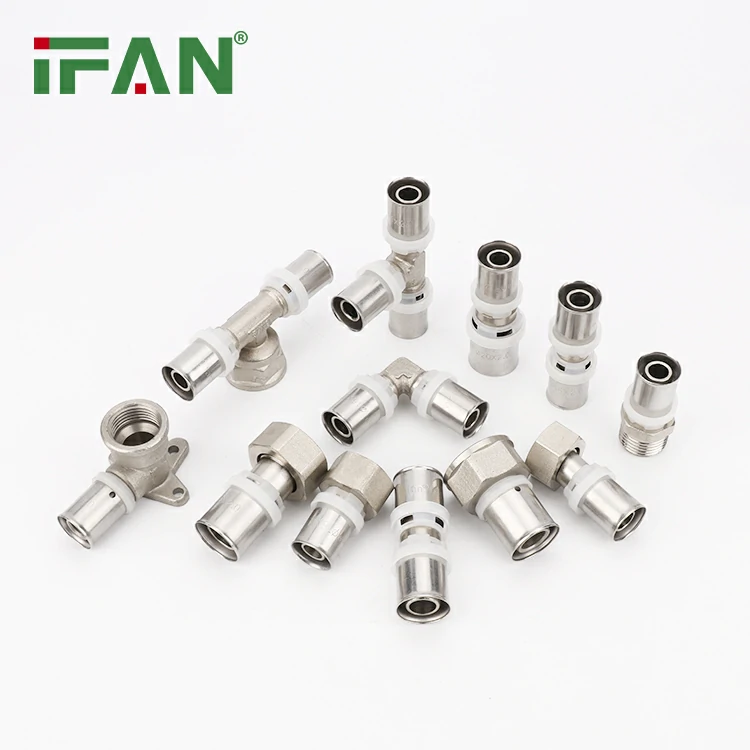
2. Material Science: The Foundation of Reliability
Brass Alloy (CW617N/DZR Brass):
- Copper (60–65%): Provides natural corrosion resistance, antimicrobial properties, and thermal conductivity.
- Zinc (30–35%): Enhances strength and machinability, ensuring precise fitting geometries.
- Dezincification-Resistant (DZR) Additives: Prevents zinc leaching in aggressive water conditions, extending lifespan.
Stainless-Steel Sleeve (304/316L):
- Grade 316L: Withstands chlorides, acids, and saline environments, making it ideal for coastal or chemical applications.
- Non-Magnetic Properties: Essential for medical gas systems and MRI facilities.
O-Ring Seals (Material-Specific):
- EPDM: For cold water (up to 250°F/121°C) and potable systems.
- FKM (Viton®): For high-temperature steam (up to 400°F/204°C) and hydrocarbon transport.
- Silicone: FDA-approved for food-grade and pharmaceutical applications.
Structural Innovations:
- Color-Coded Rings: Quick identification of fitting type (e.g., blue for cold, red for hot, green for gas).
- Beveled Edges: Guide pipe insertion smoothly, preventing O-ring damage.
- Internal Stop: Ensures consistent insertion depth for uniform pressing.
3. Installation Workflow: Speed Without Compromise
- Pipe Preparation:
- Cut pipe squarely using a rotary or tube cutter.
- Deburr edges with a reaming tool to prevent O-ring abrasion.
- Fitting Assembly:
- Slide the pipe into the fitting until it contacts the internal stop.
- Verify alignment to avoid cross-threading (if applicable).
- Pressing Process:
- Use a hydraulic or manual press tool to compress the stainless-steel sleeve around the pipe.
- Single-Action Pressing: Completes in 3–5 seconds, with audible/visual confirmation on advanced tools.
- Post-Press Inspection:
- Check for uniform deformation of the sleeve.
- Conduct a pressure test (if required by local codes).
Advantages Over Traditional Methods:
- No Heat/Flame: Eliminates fire risks and ventilation needs.
- No Solder/Flux: Reduces material costs and cleanup.
- Reversible (Select Models): Some fittings allow depressurization and re-pressing.
4. Performance Benchmarks: Engineering for Extremes
Pressure Ratings:
- Water Systems: Up to 230 PSI (15.9 bar) at 230°F (110°C).
- Gas Systems: Up to 1,200 PSI (82.7 bar) for hydrogen and medical gases.
- Steam Applications: FKM-sealed fittings handle 400°F (204°C) at 150 PSI.
Durability Metrics:
- Vibration Resistance: Withstands seismic activity and machinery-induced movement.
- Corrosion Resistance: Brass’s patina and stainless steel resist scaling, biofouling, and chemical attack.
- Lifespan: 50+ years in most environments, outperforming soldered joints.
Safety Certifications:
- NSF/ANSI 61: Potable water compliance.
- UL 207: Gas system approval.
- ASTM B280: Air conditioning and refrigeration standards.
5. Industry Applications: From Homes to Hyperloops
Residential Plumbing:
- Potable Water: Leak-free connections for single-family homes and multi-unit buildings.
- Radiant Floor Heating: Efficient distribution of heated water with minimal energy loss.
- Snowmelt Systems: Prevents ice accumulation on driveways and sidewalks.
Commercial Infrastructure:
- High-Rise Buildings: Reduces installation time by 30–50% vs. soldering.
- Hospitals: Sterile connections for oxygen, vacuum, and medical air systems.
- Data Centers: Reliable cooling loops for server racks and UPS systems.
Industrial Systems:
- Chemical Processing: Transports acids, solvents, and alkalis without degradation.
- Wastewater Treatment: Resists corrosion in slurry and abrasive media.
- Food & Beverage: FDA-compliant fittings for dairy, brewing, and CIP systems.
Emerging Frontiers:
- Geothermal Energy: Withstands high-temperature geothermal fluids (up to 300°F/149°C).
- Hydrogen Infrastructure: Leak-proof connections for fuel cell stations and pipelines.
- Marine Applications: Saltwater-resistant fittings for ships and offshore platforms.
6. Market Dynamics: Growth Driven by Innovation
Global Expansion:
- The brass press fitting market is projected to grow at a 7.2% CAGR from 2024 to 2032, reaching $5.1 billion by 2032.
- Asia-Pacific leads adoption due to urbanization and government incentives for PEX/PPR systems.
Technological Advancements:
- Smart Press Tools: IoT-enabled devices track press quality and upload data to cloud platforms for compliance.
- Biodegradable O-Rings: Eco-friendly alternatives to traditional rubber.
- Universal Fittings: Compatible with PEX, PPR, CPVC, and copper pipes, reducing inventory costs.
Sustainability Initiatives:
- Recycled Brass: Manufacturers use post-consumer scrap to reduce carbon footprint.
- Energy-Efficient Pressing: Low-power hydraulic tools minimize energy consumption.
7. Challenges and Mitigation Strategies
Cost Barriers:
- Initial Investment: Press fittings cost 20–30% more than crimp rings, but lifetime savings from reduced labor and maintenance offset the expense.
Regulatory Hurdles:
- Regional Variations: Some areas require additional certifications (e.g., California’s UPC listing). Manufacturers are obtaining global approvals to streamline distribution.
Skill Gaps:
- Training Programs: Industry associations (e.g., PHCC, ASPE) offer certification courses to ensure proper installation.
- Third-Party Testing: Reports from labs like UL or Intertek provide independent validation of performance.
8. Conclusion: The Press-Fitted Future of Piping
Brass press fittings have redefined efficiency, safety, and sustainability in piping systems. Their ability to reduce installation time by 50%, eliminate leaks, and withstand extreme conditions makes them indispensable in modern infrastructure. As innovations like smart tools and universal compatibility expand their reach, these fittings are poised to dominate not just plumbing but also emerging sectors like renewable energy, hydrogen fuel, and hyperloop transportation. By addressing cost and regulatory challenges, the industry can ensure brass press fittings remain the cornerstone of secure, long-lasting pipe connections for decades to come.
IFAN factory started in 1993. And IFAN has workshop 120000 square meter with 610 staff. IFAN can design and produce all plumbing pipe and fitting include PPR,PVC,CPVC PPSU HDPE PEXA PEXB PERT pipe and fitting ,brass fitting, brass ball valve ,heating system , gas system , sanitary faucets and hose, In the past 30 Years, IFAN has never forgotten his mission-To protect health and safety. And IFAN factory use best materials to produce high quality pipe and fittings with automatic production line and high tech quality control machines. The most important,IFAN can guarantee that all pipes and fittings manufactured by IFAN are qualified. More information pls feel free contact us Whatsapp.