
1. Product Overview & Mechanism
Brass Press Fittings are mechanical connectors that join pipes via a permanent, cold pressing method. In this process, a specialized hydraulic tool compresses a stainless steel press sleeve around the pipe and fitting, creating a uniform, leak-proof seal in seconds without heat, solder, or thread sealant. Manufacturers typically use brass—a durable and corrosion-resistant alloy—for the fitting body, making it ideal for pressurized water and approved gas systems.
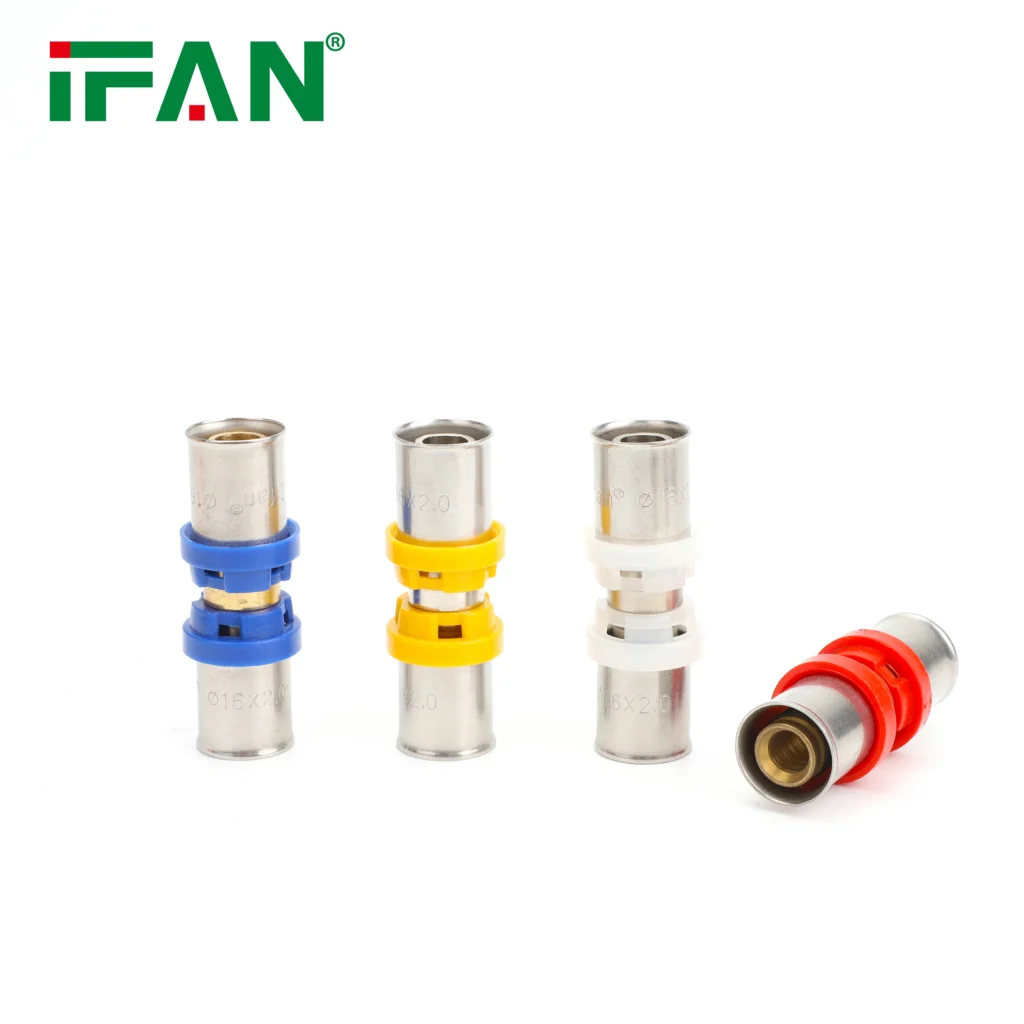
2. Key Specifications & Standards
- Materials: Body (Lead-free brass, CuZn≥85%), Sleeve (Stainless steel 304/316)
- Pressure Rating: ≥16 bar (230 psi) for water, ≥6 bar (87 psi) for gas
- Temperature Range: -20°C to 120°C for most hot and cold water applications
- Compatible Pipe: Copper tube (Types K, L, M), Stainless Steel, PEX, and Multi-layer Composite Pipe
- Certifications: NSF/ANSI 61 & 372 (lead-free), ASTM, ISO, and regional gas/water approvals
- Sizes: Commonly 15mm (½”) to 54mm (2″) diameters
3. Advantages Over Traditional Methods
Brass press fittings offer several significant benefits. First, their installation is up to five times faster than soldering or threading. Additionally, they provide exceptional reliability because the pressing process eliminates the skill variance found in manual methods. Moreover, these fittings improve job site safety by removing the need for open flames, hot work permits, or chemical fluxes. Finally, their cleanliness and versatility allow installation in confined, wet, or occupied spaces without introducing debris into the system.
4. Installation Protocol
Preparation:
- Begin by cutting the pipe squarely and deburring it thoroughly.
- Next, clean both the pipe end and fitting socket to bare metal.
- Subsequently, check pipe roundness to ensure it meets manufacturer tolerance.
- Finally, mark the insertion depth on the pipe using the provided go/no-go gauge.
Pressing Process:
- First, slide the press sleeve onto the pipe if it is not pre-attached.
- Then, fully insert the pipe into the fitting until it bottoms out.
- After that, position the correct jaw set around the sleeve.
- Following this, activate the press tool until the cycle completes and the tool releases.
- Consequently, you can then visually inspect for a uniform 360° indentation.
Commissioning:
- Pressure test the system according to local code, typically at 1.5x working pressure.
- Furthermore, ensure no rotation or movement occurs at the joints.
- Finally, document the installation with photos or logs for warranty validation.
5. Tooling & System Requirements
Installers need specific equipment for this system. Primarily, they require press tools, which come in battery, electric, or manual hydraulic models and are typically brand-specific. Additionally, color-coded jaw sets are necessary for different sizes and materials and require periodic calibration. Moreover, accessories like pipe cutters, deburring tools, and calibration gauges are essential. Overall, a professional tool kit represents an initial investment of approximately $800 to $2,500.
6. Primary Applications
Plumbing & Heating:
These fittings are widely used in domestic hot and cold water distribution. Similarly, they suit radiator connections, underfloor heating systems, and commercial hydronic piping. Furthermore, professionals commonly use them for water heater and boiler hookups.
Gas Systems:
In many regions, approved gas-rated brass press fittings are used for natural gas and LPG lines. Specifically, they are applied in meter sets and appliance connectors where local codes permit.
Industrial & Commercial:
Their reliability makes them ideal for process water lines and oil-free compressed air systems. Additionally, specially certified versions serve in medical gas installations.
7. Limitations & Considerations
Despite their advantages, brass press fittings have certain limitations. Primarily, they require a higher upfront investment in tools and fittings. Furthermore, users often face brand lock-in, as fittings and tools are generally not cross-compatible. Another consideration is that the pipe must be perfectly round, clean, and free of deep scratches. Additionally, some jurisdictions require special installer certification. Finally, the joints are permanent; any changes require cutting out and using new fittings.
8. Quality Assurance & Troubleshooting
Pre-Installation Checks:
- First, verify fitting and pipe material compatibility.
- Next, ensure jaws are the correct size and properly calibrated.
- Finally, confirm the system design pressure does not exceed the fitting rating.
Common Failure Modes & Solutions:
- Incomplete Press: Use the correct jaw size and ensure a full tool cycle.
- Pipe Not Seated: The joint must be cut out and redone; never attempt to re-press.
- Wrong Sleeve Size: Similarly, the joint must be replaced entirely.
- Corrosion Concern: Use dielectric isolation when connecting to dissimilar metals.
Warranty & Compliance:
Most manufacturers offer a 25+ year warranty when fittings are installed per instructions. However, installers must follow all local plumbing and gas codes. Therefore, maintaining records of tool calibration and installer certification is crucial.
9. Comparison to Alternative Methods
vs. Soldered Joints:
- Press Advantage: Faster, cleaner, no fire risk, and works on wet pipe.
- Soldering Advantage: Conversely, it has lower material cost and no special tool investment.
vs. PEX Crimp Systems:
- Press Advantage: More consistent, faster, and better for metallic pipes.
- PEX Crimp Advantage: On the other hand, it offers lower fitting cost and lighter weight tools.
vs. Threaded Fittings:
- Press Advantage: No thread sealing issues, faster installation, and no torque sensitivity.
- Threaded Advantage: In contrast, it is reusable, widely available, and has lower fitting cost.
10. Professional Best Practices
- Training: Ensure all installers are factory-trained or certified.
- Tool Care: Calibrate jaws every 5,000–10,000 presses or annually.
- System Design: Additionally, always allow for thermal expansion in long runs.
- Identification: Where available, use color-coded sleeves for easy system identification.
- Documentation: Finally, maintain a log of installation dates, pressures, and locations for future reference.
SUMMARY: Brass Press Fittings offer a fast, reliable, and code-compliant joining method for modern piping systems. While requiring an initial investment in proprietary tools, they provide significant labor savings, enhanced safety, and consistent joint quality. Consequently, they are especially valuable in commercial, multi-family, and retrofit applications. Success depends on using compatible components, following manufacturer instructions precisely, and ensuring proper installer training. In conclusion, for professionals seeking to improve efficiency and reduce callbacks in plumbing, heating, and approved gas applications, brass press systems represent a proven and future-oriented technology.
IFAN factory started in 1993. And IFAN has workshop 120000 square meter with 610 staff. IFAN can design and produce all plumbing pipe and fitting include PPR,PVC,CPVC PPSU HDPE PEXA PEXB PERT pipe and fitting ,brass fitting, brass ball valve ,heating system , gas system , sanitary faucets and hose, In the past 30 Years, IFAN has never forgotten his mission-To protect health and safety. And IFAN factory use best materials to produce high quality pipe and fittings with automatic production line and high tech quality control machines. The most important,IFAN can guarantee that all pipes and fittings manufactured byIFAN are qualified. More information pls feel free contact us Whatsapp.