Introduction
A
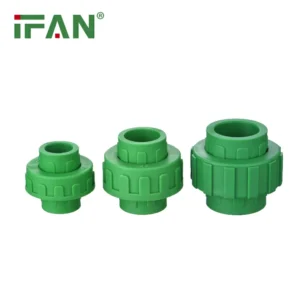
PPR fitting union is a critical component in
polypropylene random copolymer (PPR) piping systems, designed to facilitate
easy disassembly and reassembly of pipes without cutting or welding. Unlike rigid couplings, PPR unions feature a
three-part design—a nut, a female end, and a male end—that allows for quick connections and separations. This makes them indispensable for
maintenance, repairs, and modular installations in residential, commercial, and industrial plumbing. This guide explores their structure, advantages, installation steps, and best-use scenarios to help you optimize your piping projects.

What Is a PPR Fitting Union?
A
PPR union is a
detachable connector used to join two PPR pipes or fittings while allowing future disconnection without damage. Its key components include:
- Female End: A socket-like fitting that receives the male end.
- Male End: A spigot-shaped piece that inserts into the female end.
- Union Nut: A threaded ring that tightens around the female end to create a watertight seal.
When the nut is tightened, it compresses a
rubber O-ring (or metal gasket in high-pressure systems) between the male and female ends, ensuring
leak-proof performance. PPR unions are compatible with
heat-fusion welding, enabling permanent bonds when needed, or they can function as
mechanical joints for temporary setups.
Key Features of PPR Fitting Unions
- Reusability: Unlike glued or welded joints, PPR unions can be disconnected and reconnected multiple times, saving time and material costs during repairs.
- Heat-Fusion Compatibility: The male/female ends can be heat-fused to PPR pipes for a permanent, monolithic bond, eliminating the need for additional adhesives.
- Chemical Resistance: PPR material is inert to acids, alkalis, and chlorine, making unions suitable for aggressive environments like chemical plants or swimming pools.
- Temperature Tolerance: Rated for -20°C to 95°C, PPR unions handle both cold and hot water applications without warping or cracking.
- Corrosion-Free: Unlike metal unions (e.g., brass or stainless steel), PPR unions do not rust, ensuring long-term reliability in humid or saline conditions.
- Lightweight Design: Easier to transport and install compared to heavy metal alternatives, reducing labor fatigue.
Types of PPR Fitting Unions
- Standard PPR Union
- The most common type, featuring a single O-ring seal for general-purpose plumbing (e.g., residential water lines).
- Double O-Ring PPR Union
- Includes two seals for enhanced leak protection in high-pressure systems like industrial boilers or compressed air lines.
- Threaded PPR Union
- Combines a PPR body with male/female threads on one or both ends (e.g., a 32mm PPR union with a 1″ BSP thread) to connect metal fixtures like valves or pumps.
- Reducing PPR Union
- Joins pipes of different diameters (e.g., 32mm x 25mm) in a single union, eliminating the need for separate reducers.
- Flange PPR Union
- Features flange connections on both ends for bolting to large-diameter pipes or equipment like tanks or heat exchangers.
Primary Applications
- Residential Plumbing
- Connect water heaters, washing machines, or dishwashers to supply lines, enabling easy appliance replacement without pipe cutting.
- Commercial HVAC Systems
- Facilitate maintenance of chilled water loops, condensate drains, or boiler feed pipes in office buildings and hospitals.
- Industrial Piping
- Link pipes in chemical processing plants, food manufacturing facilities, or wastewater treatment systems where frequent disconnection is required.
- Underfloor Heating
- Allow sectional repairs in hot water loops beneath floors without draining the entire system.
- Irrigation Systems
- Simplify maintenance of drip lines or sprinkler pipes in agricultural fields or landscaped gardens by enabling quick valve or filter replacements.
Advantages Over Traditional Couplings
- Time Efficiency: Disconnecting a PPR union takes seconds versus hours of cutting and re-welding rigid couplings.
- Cost Savings: Reusable design reduces material waste and labor costs for repairs.
- Versatility: Combines mechanical and heat-fusion connection options in one fitting.
- Space Optimization: Compact design fits tight spaces where traditional flanges or valves cannot.
- Safety: No open flames or toxic adhesives are needed during installation, minimizing fire and health risks.
Installation Guide: Step-by-Step Process
- Prepare the Pipes
- Cut PPR pipes to length using a rotary pipe cutter for clean, burr-free edges. Avoid hacksaws, which can create jagged ends.
- Dry-Fit Components
- Assemble the union (nut, female end, male end) without tightening to check alignment and ensure full insertion of the male end into the female socket.
- Heat-Fuse the Ends (Optional)
- For a permanent bond, use a PPR heat gun (260–270°C) to heat the male and female ends for 5–10 seconds, then fuse them to the pipes. Skip this step for mechanical joints.
- Lubricate the O-Ring
- Apply a silicone-based lubricant to the O-ring to ensure smooth tightening and prevent leaks. Avoid petroleum-based products, which can degrade rubber.
- Tighten the Union Nut
- Hand-tighten the nut first, then use a wrench to turn it an additional 1–2 full rotations for a secure seal. Avoid over-tightening, which can crack the PPR.
- Pressure Test
- After installation, conduct a hydrostatic test at 1.5x the system’s operating pressure for 30 minutes to verify no leaks.
Maintenance and Safety Tips
- Inspect O-Rings Regularly: Replace worn or cracked seals immediately to prevent leaks.
- Avoid UV Exposure: Prolonged sunlight can weaken PPR. Use UV-resistant paint or insulation for outdoor installations.
- Prevent Freezing: Insulate pipes in cold climates to avoid cracking from ice expansion.
- Use Compatible Tools: Only heat PPR unions with certified tools to prevent overheating (which melts the material).
- Label Connections: Use tags to identify hot/cold water lines or chemical transport pipes for future maintenance.
Conclusion
PPR fitting unions are a game-changer for plumbing systems requiring
flexibility, durability, and ease of maintenance. Their
reusable design, chemical resistance, and heat-fusion compatibility make them superior to traditional couplings in residential, commercial, and industrial applications. By following proper installation techniques—such as precise cutting, lubricated O-rings, and pressure testing—professionals and DIYers can create reliable, leak-proof connections that simplify future repairs. Whether for a quick dishwasher swap or an industrial pipe network, PPR unions offer unmatched convenience and performance.
IFAN factory started in 1993. And
IFAN has workshop 120000 square meter with 610 staff.
IFAN can design and produce all plumbing pipe and fitting include PPR,PVC,CPVC PPSU HDPE PEXA PEXB PERT pipe and fitting ,brass fitting, brass ball valve ,heating system , gas system , sanitary faucets and hose, In the past 30 Years,
IFAN has never forgotten his mission-To protect health and safety. And
IFAN factory use best materials to produce high quality pipe and fittings with automatic production line and high tech quality control machines. The most important,
IFAN can guarantee that all pipes and fittings manufactured by
IFAN are qualified. More information pls feel free contact us
Whatsapp.



 PPR
PPR