
The Complete Guide to CPVC Fittings: Reliable Hot Water System Solutions
Modern plumbing systems require materials that can withstand high temperatures while maintaining cost-effectiveness and ease of installation. CPVC fittings, manufactured from chlorinated polyvinyl chloride, provide exceptional performance for both hot and cold water distribution systems. These specialized fittings offer superior temperature resistance compared to standard PVC, making them ideal for residential, commercial, and industrial plumbing applications. Whether you’re working on whole-house repiping, commercial hot water systems, or industrial process lines, understanding CPVC fittings is essential for creating durable and reliable plumbing systems.
The chlorination process enhances PVC’s temperature tolerance, allowing CPVC fittings to handle hot water up to 200°F (93°C) while maintaining structural integrity. This thermal capability, combined with excellent corrosion resistance, makes CPVC an ideal choice for potable water systems. Moreover, the solvent welding installation method creates permanent, leak-proof joints that become stronger than the pipe itself. Consequently, CPVC fittings have become a preferred choice for plumbing professionals seeking reliable, cost-effective solutions for hot water applications.
This comprehensive guide examines CPVC fittings from multiple perspectives, covering material properties, installation techniques, selection criteria, and maintenance considerations to help you make informed decisions for your plumbing projects.
Understanding CPVC Fittings
CPVC fittings are piping components manufactured from post-chlorinated polyvinyl chloride, a thermoplastic that undergoes additional chlorination to enhance its temperature resistance and mechanical properties. These fittings are specifically designed for hot and cold water distribution systems, offering superior performance compared to standard PVC in high-temperature applications. The chlorination process increases the chlorine content from approximately 56% to around 67%, significantly improving the material’s heat distortion temperature and overall thermal capabilities.
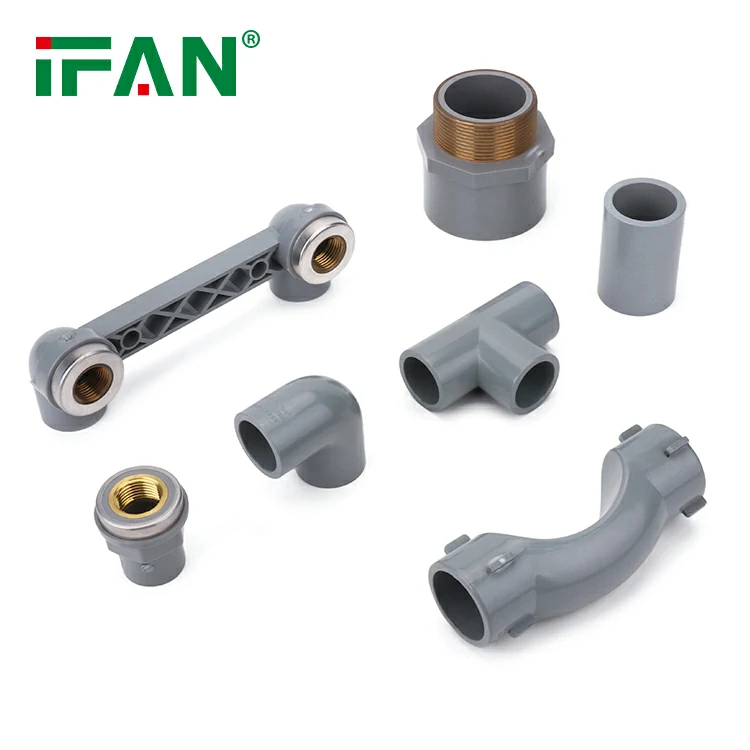
CPVC material maintains excellent corrosion resistance, preventing rust and scale buildup that can plague metal piping systems. The fittings are available in various configurations including elbows, tees, couplings, and adapters, all designed for solvent cement joining. This chemical fusion process creates a permanent, monolithic bond that exceeds the strength of the pipe material itself. The smooth interior surface of CPVC fittings minimizes flow resistance and pressure drop, contributing to overall system efficiency.
Key Advantages of CPVC Fittings
The chlorinated polyvinyl chloride construction offers numerous significant benefits:
High Temperature Resistance: Suitable for hot water up to 200°F (93°C)
Excellent Corrosion Resistance: Immune to rust and electrolytic corrosion
Scale Prevention: Smooth interior prevents mineral buildup
Cost-Effective: Lower material and installation costs than metal alternatives
Easy Installation: Simple solvent welding process
Long Service Life: 50+ years of reliable performance
Lightweight: Easy handling and transportation
Low Thermal Conductivity: Reduces heat loss and energy costs
Professional Installation Guidelines
Proper installation ensures optimal performance and system integrity:
Preparation Phase:
Pipe Cutting: Cut CPVC pipe square using plastic pipe cutter
Deburring: Remove all internal and external burrs
Surface Cleaning: Clean both pipe end and fitting socket with CPVC cleaner
Dry Fit Check: Verify proper fit and alignment before cementing
Solvent Welding Process:
Primer Application: Apply CPVC primer to both pipe and fitting surfaces
Cement Application: Apply uniform coat of CPVC cement to both surfaces
Assembly: Quickly insert pipe into fitting with quarter-turn motion
Holding Time: Hold firmly for 30 seconds to prevent push-out
Curing Time: Allow proper cure time before pressure testing
Excess Removal: Wipe away excess cement from joint exterior
Quality Assurance:
Visual Inspection: Check for complete cement coverage and proper insertion
Joint Examination: Verify continuous cement bead around joint
Pressure Testing: Conduct system test after proper cure time
Documentation: Record installation details for future reference
Available Configurations
Multiple fitting types accommodate various system requirements:
Socket Fittings: For solvent weld connections
Threaded Fittings: For transition to metal piping systems
Flange Adapters: For connection to flanged equipment
Union Fittings: For easy maintenance and disassembly
Reducer Fittings: For size transition applications
Specialty Fittings: Custom configurations for specific needs
Selection Considerations
Key factors for optimal fitting selection:
Temperature Requirements: Verify maximum operating temperature
Pressure Rating: Select appropriate schedule (80 or 40)
Size Compatibility: Match to CPVC pipe size and schedule
Chemical Compatibility: Check for specific chemical exposure
Quality Certifications: Look for NSF, ASTM, and UL certifications
Application Type: Potable water, industrial, or chemical service
Code Compliance: Ensure compliance with local plumbing codes
Brand Compatibility: Use same manufacturer for pipes and fittings
Technical Specifications
Pressure Rating: 100-400 PSI (depending on size and temperature)
Temperature Range: 33°F to 200°F (0.6°C to 93°C)
Chemical Resistance: Excellent against most acids, bases, and salts
Material: Chlorinated Polyvinyl Chloride (CPVC)
Size Range: ½” to 12″ diameters
Standards: ASTM D2846, NSF 14, NSF 61
Frequently Asked Questions
Q: Can CPVC fittings be used for both hot and cold water? A: Yes, they are specifically designed for both hot and cold water applications.
Q: What’s the difference between CPVC and PVC? A: CPVC handles higher temperatures (200°F vs. 140°F for PVC).
Q: Are CPVC fittings drinking water safe? A: Yes, when certified to NSF/ANSI 61 standards.
Q: Can CPVC be used outdoors? A: Yes, but requires UV protection for prolonged outdoor exposure.
Q: How long do solvent welded joints take to cure? A: Full cure requires 24 hours, but pressure testing can often be done sooner.
Common Applications
Essential for numerous plumbing scenarios:
Residential Plumbing: Whole-house hot and cold water distribution
Commercial Buildings: Hotel, hospital, and school plumbing systems
Industrial Plants: Process water and cooling systems
Fire Sprinkler Systems: Residential fire protection
Chemical Processing: Handling certain corrosive chemicals
Water Treatment: Chemical feed and distribution lines
Maintenance Best Practices
Ensure long-term performance and reliability:
Regular Inspection: Check for leaks or physical damage
Pressure Monitoring: Watch for pressure drops indicating issues
Support Verification: Ensure proper hanger spacing and support
UV Protection: Maintain protective coating for outdoor installations
System Flushing: Periodic flushing to maintain water quality
Record Keeping: Maintain installation and maintenance records
Conclusion: Reliable Hot Water Solutions
CPVC fittings provide exceptional performance for hot and cold water distribution systems, offering superior temperature resistance and corrosion protection. Their cost-effectiveness, ease of installation, and long service life make them an ideal choice for residential, commercial, and industrial applications. Furthermore, the solvent welding installation method creates permanent, leak-proof joints that ensure system reliability for decades.
IFAN factory started in 1993. And IFAN has workshop 120000 square meter with 610 staff. IFAN can design and produce all plumbing pipe and fitting include PPR,PVC,CPVC PPSU HDPE PEXA PEXB PERT pipe and fitting ,brass fitting, brass ball valve ,heating system , gas system , sanitary faucets and hose, In the past 30 Years, IFAN has never forgotten his mission-To protect health and safety. And IFAN factory use best materials to produce high quality pipe and fittings with automatic production line and high tech quality control machines. The most important,IFAN can guarantee that all pipes and fittings manufactured by IFAN are qualified. More information pls feel free contact us Whatsapp.Related products