
PP ball valves are essential flow control devices manufactured from high-quality polypropylene, designed specifically for corrosive fluid handling applications. These valves feature a quarter-turn operation mechanism with a rotating ball that controls fluid passage through a precision-machined bore. The all-polypropylene construction ensures complete chemical compatibility with aggressive media while providing reliable bubble-tight shutoff capability in various industrial processes.
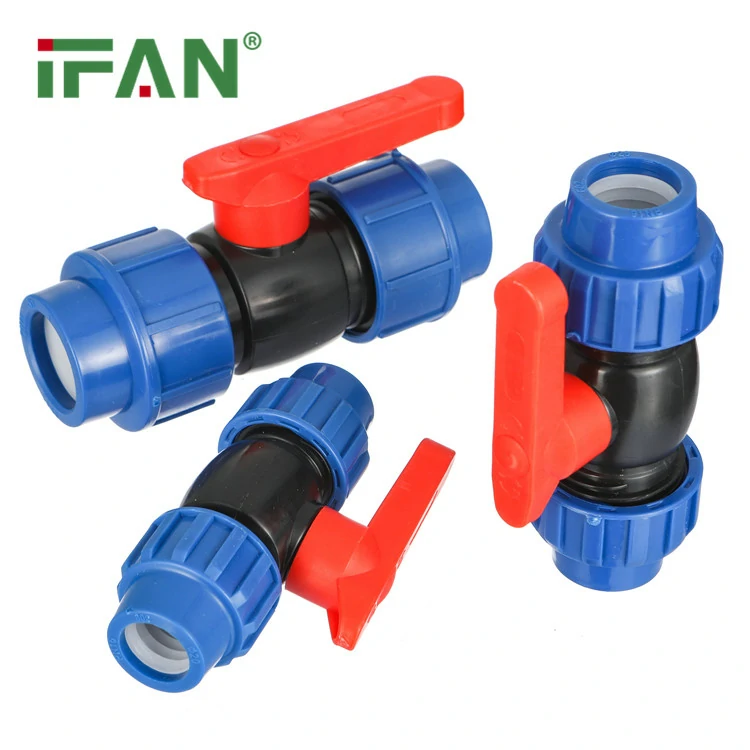
Product Specifications
PP ball valves comply with international standards including ISO 161-1 and ASTM D4101. Standard sizes range from 20mm to 110mm to match common PP piping dimensions. Pressure ratings include PN10 and PN16 classifications, supporting working pressures up to 16 bar at 20°C. Temperature resistance spans from -20°C to 95°C, making them suitable for both chemical processing and water applications. The valves feature reinforced PP bodies, chromium-plated brass or stainless steel balls, and EPDM or FKM seals for optimal chemical resistance.
Installation Guidelines
Proper installation begins with careful preparation and positioning. Cut the PP pipe ends square using a dedicated plastic pipe cutter and remove all burrs. Ensure the valve is in the open position during installation to prevent damage to sealing components. Use calibrated socket fusion equipment set to 260°C ± 5°C for optimal joint quality. Heat both the valve sockets and pipe ends simultaneously for the specified duration. Join components quickly without rotation and maintain pressure during the cooling period. Support the piping adequately on both sides of the valve to prevent stress on the fusion joints.
Applications and Industry Uses
These valves serve critical functions across multiple industrial sectors. Chemical processing plants utilize them for handling acids, alkalis, and corrosive chemicals. Water treatment facilities employ PP ball valves for filtration systems and chemical dosing lines. Pharmaceutical manufacturers rely on them for process water and chemical transfer systems. Industrial plants incorporate these valves in wastewater treatment and cooling water circuits. Agricultural applications benefit from their corrosion resistance in fertilizer and chemical injection systems.
Maintenance and Operational Considerations
Regular maintenance ensures long-term reliability and performance. Exercise the valve periodically to prevent sticking and maintain smooth operation. Monitor for signs of leakage around the stem area and address promptly. Check for smooth handle operation and lubricate if recommended by the manufacturer. For systems with particulate matter, occasional flushing may be necessary. Always use manufacturer-approved replacement parts for repairs. Keep valves accessible for operation and maintenance, ensuring proper identification and labeling.
Quality Assurance
Implement strict quality control measures during installation and operation. Conduct visual inspections of fusion joints and valve alignment. Perform pressure testing at 1.5 times working pressure before system commissioning. Verify proper support and accessibility for all installed valves. Maintain comprehensive documentation including installation records, pressure test results, and maintenance history. Regular training for operational staff ensures proper valve handling and maintenance procedures.
Conclusion
PP ball valves provide reliable, corrosion-resistant flow control solutions for demanding industrial applications. Their all-polypropylene construction ensures complete material compatibility with aggressive chemicals while the fusion joint technology creates permanent, leak-proof connections. Proper selection based on chemical compatibility, pressure rating, and temperature requirements guarantees optimal system performance. Adherence to correct installation procedures and regular maintenance practices ensures decades of trouble-free service. These valves represent the ideal choice for applications requiring chemical resistance, reliability, and easy operation in corrosive environments.
IFAN factory started in 1993. And IFAN has workshop 120000 square meter with 610 staff. IFAN can design and produce all plumbing pipe and fitting include PPR,PVC,CPVC PPSU HDPE PEXA PEXB PERT pipe and fitting ,brass fitting, brass ball valve ,heating system , gas system , sanitary faucets and hose, In the past 30 Years, IFAN has never forgotten his mission-To protect health and safety. And IFAN factory use best materials to produce high quality pipe and fittings with automatic production line and high tech quality control machines. The most important,IFAN can guarantee that all pipes and fittings manufactured by IFAN are qualified. More information pls feel free contact us Whatsapp.