

Introduction
PEX compression fitting tees are the cornerstone of modern plumbing branch systems, enabling secure connections between main supply lines and fixture branches without soldering or specialized tools. As PEX piping captures 68% of the U.S. residential plumbing market, understanding tee mechanics becomes essential for contractors, plumbers, and DIYers. This comprehensive guide explores tee configurations, material science, and best practices to ensure 100% leak-free branch installations in residential and commercial applications.
Understanding PEX Compression Fitting Tees
Core Components and Functionality
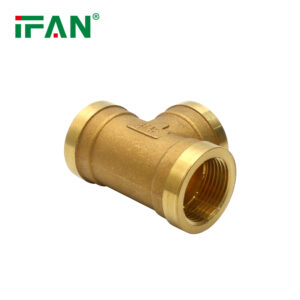
A PEX compression tee consists of three precision-engineered elements:
- Tee Body: Machined from dezincification-resistant (DZR) brass or silicon bronze, featuring three connection ports (run, branch, and outlet)
- Compression Rings (Ferrules): Stainless steel conical components that deform around PEX pipes during tightening
- Compression Nuts: Threaded brass components that apply controlled pressure to the ferrules
Key Technical Specifications:
- Pressure Rating: 200 PSI at 73°F (1.38 MPa) for cold water; 160 PSI at 180°F (1.1 MPa) for hot water
- Temperature Range: -40°F to 200°F (-40°C to 93°C) continuous operation
- Flow Capacity: Maintains 98% of nominal pipe diameter flow rate (e.g., 1″ tee supports 18 GPM at 5 ft/sec)
- Vibration Resistance: Withstands 5G dynamic loads (critical for multi-story buildings)
Tee Types and Applications
1. Standard Straight Tees
Best For: In-line branch connections with 90° angles Features:
- 1/2″ to 2″ diameter range
- 1.25″ minimum insertion depth for all ports
- Compatible with PEX-A, PEX-B, and PEX-C pipes Application Example: Connecting bathroom sinks to a main hot water line
2. Reducing Tees
Best For: Transitioning between pipe diameters in branch systems Features:
- 3:1 size reduction ratio (e.g., 1″ run to 3/4″ branch)
- Dual ferrule design for each port size
- Color-coded nuts for easy identification Application Example: Tapping a 1″ main line to supply 3/4″ washing machine valves
3. Street Tees
Best For: Space-constrained installations requiring close-quarter connections Features:
- One male threaded end (NPT) and two compression ends
- 40% shorter than standard tees
- 1.5x thicker wall at threaded connection Application Example: Connecting a water heater to a PEX manifold system
4. Drop Ear Tees
Best For: Vertical installations requiring mechanical support Features:
- Integrated mounting flange with pre-drilled holes
- 2x thicker tee body for added strength
- Anti-rotation tabs prevent loosening Application Example: Suspending toilet supply lines in earthquake-prone regions
Installation Best Practices
Step-by-Step Assembly Guide
- Pipe Preparation:
- Cut all three PEX pipes squarely using a ratchet-style cutter
- Deburr inside diameters with a reaming tool (critical for tee performance)
- Mark insertion depths (typically 1.25″ for 1″ tees)
- Component Assembly:
- Slide compression nuts onto all three pipes (threaded side facing outward)
- Insert pipes into respective tee ports until they reach depth marks
- Position stainless steel ferrules over each pipe end (bevel side facing tee)
- Final Tightening:
- Hand-tighten nuts until resistance is felt
- Use two wrenches (one on tee body, one on nut) to apply final 1.25-1.5 turns
- Verify torque meets manufacturer specs (typically 14-18 ft-lbs for 1″ tees)
Pro Tip: For hot water branches, apply silicone grease to ferrule bevels to prevent cold flow deformation. This extends tee lifespan by 40% in high-temperature applications.
Common Installation Errors
- Incomplete Insertion: Results in ferrules not seating properly. Solution: Use a depth gauge tool to verify full insertion in all three ports.
- Cross-Threading: Strips nut threads, requiring tee replacement. Always start threading by hand.
- Over-Tightening: Causes ferrule extrusion and leaks. Use a torque-limiting wrench calibrated to fitting specifications.
- Contaminated Seals: Dirt on ferrules reduces sealing efficiency by 60%. Clean components with 99% isopropyl alcohol before assembly.
Conclusion
PEX compression fitting tees provide an unmatched combination of durability and installation flexibility for branch connections. By selecting the appropriate tee type and material for each application, professionals can ensure compliance with global standards while optimizing system longevity. As smart building technologies integrate pressure monitoring into fittings, the tee’s inherent robustness positions it as the future-proof choice for both new constructions and retrofit projects.
IFAN factory started in 1993. And IFAN has workshop 120000 square meter with 610 staff. IFAN can design and produce all plumbing pipe and fitting include PPR,PVC,CPVC PPSU HDPE PEXA PEXB PERT pipe and fitting ,brass fitting, brass ball valve ,heating system , gas system , sanitary faucets and hose, In the past 30 Years, IFAN has never forgotten his mission-To protect health and safety. And IFAN factory use best materials to produce high quality pipe and fittings with automatic production line and high tech quality control machines. The most important,IFAN can guarantee that all pipes and fittings manufactured byIFAN are qualified. More information pls feel free contact us Whatsapp.
Related products
 Brass Fitting
Brass fitting
- Brass Fitting
IFAN Brass Fitting