


PPR Water Pipe Fittings: Comprehensive Guide
1. Product Overview
PPR Water Pipe Fittings are specialized components manufactured from Polypropylene Random Copolymer. Specifically designed for potable water systems, these fittings connect PPR pipes through heat fusion technology. As a result, they create permanent, monolithic joints that ensure leak-proof performance in both residential and commercial water distribution networks. Unlike traditional metal fittings, PPR fittings are corrosion-resistant and hygienic. Moreover, they require zero maintenance throughout their 50+ year service life.
2. Material Specifications
Base Material: PPR Type 3 (Random Copolymer with 3-6% ethylene content)
Temperature Resistance: Continuous operation at 70°C (158°F), and it withstands short-term peaks to 95°C (203°F)
Pressure Ratings: PN10 (10 bar), PN16 (16 bar), PN20 (20 bar), and PN25 (25 bar)
Color Coding: White (standard cold water), Green (hot water identification), and Gray (industrial applications)
Certifications: These include NSF/ANSI 61 (potable water), ISO 15874, ASTM F2389, WRAS, and KIWA
Chemical Resistance: Importantly, it is inert to chlorine, water treatment chemicals, and scale formation
3. Fitting Types & Configurations
Connection Fittings:
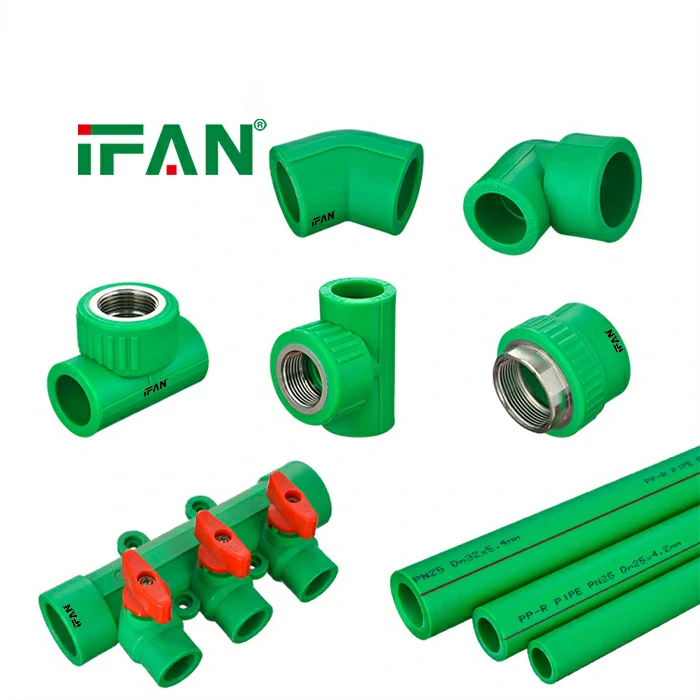
Elbows: 90° and 45° angles in both equal and reducing types
Tees: Straight, reducing, and cross configurations
Couplings: Straight connectors, reducing couplings, and repair couplings
End Caps: Used for terminating pipe runs
Transition & Service Fittings:
Adapters: Such as threaded (BSP/NPT), flange, and compression adapters
Valves: Including ball valves, check valves, and thermostatic mixing valves
Special Fittings: For example, manifolds, unions, service saddles, and air vents
Expansion Components: Namely, compensators and sliding supports
Size Range:
Standard diameters range from 20mm to 110mm
Additionally, wall thickness varies according to pressure rating
Furthermore, they are available in both metric and imperial equivalents
4. Installation Technology
Heat Fusion Process:
This installation method utilizes thermal fusion. Specifically, both the pipe end and fitting socket are simultaneously heated to a melting temperature of 260°C ± 5°C. Subsequently, they are joined to form a homogeneous connection that is stronger than the base material.
Step-by-Step Installation:
Preparation: First, cut the pipe squarely using a PPR-specific cutter, then deburr the edges and clean the surfaces
Marking: Next, indicate the insertion depth using the manufacturer’s gauge
Heating: After that, apply heat evenly for the prescribed time, which varies by diameter
Joining: Then, connect the components immediately without rotation while maintaining alignment
Cooling: Following this, allow for natural cooling without disturbance
Testing: Finally, pressure test after complete cooling, which typically takes 2-10 minutes
Quality Indicators:
Uniform bead formation around the entire circumference
Proper insertion depth achieved
Smooth transition between pipe and fitting
Importantly, no gaps or visual imperfections should be present
5. Performance Advantages
Hydraulic Efficiency:
Smooth interior surfaces minimize friction losses
Furthermore, full-flow designs reduce pressure drop
Consequently, no turbulence is created at joint interfaces
Durability & Reliability:
Complete corrosion immunity ensures long-term performance
Additionally, there is excellent resistance to water treatment chemicals
Moreover, superior thermal cycling performance is guaranteed
Finally, UV-stabilized options are available for exposed applications
Health & Safety:
Non-toxic, lead-free composition promotes water safety
Furthermore, it inhibits bacterial biofilm formation
Importantly, no leaching of heavy metals or organic compounds occurs
Additionally, it possesses self-extinguishing fire-resistant properties
Economic Benefits:
Lower installed cost compared to copper systems
Moreover, reduced labor time versus threading/soldering methods saves money
Minimal maintenance requirements further reduce long-term costs
Finally, energy savings are achieved through superior insulation properties
6. Application Spectrum
Residential Systems:
Whole-house water distribution for both cold and hot water
Additionally, water heater connections and recirculation lines
Appliance supply lines for devices like dishwashers and washing machines
Furthermore, fixture connections and outdoor water supply
Commercial/Institutional:
Multi-story building risers and distribution networks
Moreover, hotel and hospital plumbing systems benefit greatly
School and office building water supply installations
Also, food service and laboratory installations
Special Applications:
Potable water systems in corrosive environments
Solar water heating systems
Additionally, water treatment plant piping
Finally, agricultural and irrigation systems
7. Selection Criteria
Technical Parameters:
Operating pressure and temperature requirements
Additionally, water quality and chemical composition must be considered
Environmental conditions, such as indoor/outdoor or buried/exposed
Moreover, system expansion and movement considerations are crucial
Quality Assessment:
Third-party certification marks provide assurance
Furthermore, manufacturer’s quality control documentation should be reviewed
Batch testing results and material traceability add another layer of confidence
Finally, warranty terms and conditions must be thoroughly understood
Design Considerations:
Flow rate requirements and velocity limitations
Pressure loss calculations through fittings
Additionally, thermal expansion accommodation is necessary
Furthermore, access requirements for maintenance and service should be planned
8. Professional Best Practices
Design Phase:
First, conduct hydraulic calculations for proper sizing
Then, plan for thermal expansion in long runs
Next, specify appropriate pressure ratings
Finally, create detailed installation drawings
Installation Protocols:
Maintain a clean work environment throughout
Furthermore, follow manufacturer’s fusion parameters exactly
Use calibrated equipment that is regularly checked
Additionally, implement quality control checkpoints
Commissioning Procedures:
Begin with thorough pressure testing
Then, proceed with system flushing and disinfection
Next, ensure documentation of all connections
Finally, provide training for maintenance personnel
9. Standards & Compliance
International Standards:
ISO 15874 for plastics piping systems for hot and cold water
ASTM F2389 for pressure-rated polypropylene piping
EN 12201 for European water supply plastics piping systems
AS/NZS 4130 for Australian/New Zealand polyethylene and polypropylene piping
Regional Requirements:
In Europe, CE marking and national building code compliance are mandatory
In North America, local plumbing code approvals and ICC evaluation reports are required
In the Middle East, GCC standardization requirements must be met
In Asia, national standards bureau certifications are essential
10. Sustainability Profile
Environmental Benefits:
Lower embodied energy than metal alternatives
Furthermore, they are fully recyclable at end of service life
Energy efficient during operation due to excellent insulation
Importantly, no hazardous material concerns during installation or use
Life Cycle Analysis:
Production involves energy-efficient manufacturing processes
Installation generates minimal waste
Operation requires no maintenance chemicals
Finally, end-of-life offers complete recyclability potential
Health Impact:
Improves water quality by preventing corrosion byproducts
Additionally, reduces energy consumption for water heating
Moreover, minimizes maintenance disruptions and material waste
11. Market Evolution
Current Trends:
Increased adoption in green building projects
Furthermore, growing preference over copper in cost-sensitive markets
Expansion into municipal water distribution systems
Additionally, development of larger diameter fittings for commercial applications
Future Developments:
Smart fitting integration with monitoring capabilities
Enhanced high-temperature formulations
Moreover, improved installation technology for faster fusion
Furthermore, greater standardization across global markets
Professional Implications:
Continuing education requirements for new technologies
Additionally, tool investment in evolving connection methods
Specialization opportunities in premium installations
Finally, competitive advantage through quality differentiation
SUMMARY: PPR water pipe fittings represent a technologically advanced solution for modern potable water systems. They combine material science excellence with practical installation benefits. Specifically, their heat fusion joining method creates permanent, leak-proof connections while their corrosion resistance ensures decades of maintenance-free service. However, proper application requires understanding of pressure ratings, temperature limitations, and installation protocols. Consequently, these fittings offer professionals a reliable, cost-effective alternative to traditional materials. Therefore, for projects demanding durable, hygienic, and efficient water distribution systems, PPR fittings provide a proven solution backed by international standards. Ultimately, they are an ideal choice for residential, commercial, and institutional water systems worldwide.
IFAN factory started in 1993. And IFAN has workshop 120000 square meter with 610 staff. IFAN can design and produce all plumbing pipe and fitting include PPR,PVC,CPVC PPSU HDPE PEXA PEXB PERT pipe and fitting ,brass fitting, brass ball valve ,heating system , gas system , sanitary faucets and hose, In the past 30 Years, IFAN has never forgotten his mission-To protect health and safety. And IFAN factory use best materials to produce high quality pipe and fittings with automatic production line and high tech quality control machines. The most important,IFAN can guarantee that all pipes and fittings manufactured byIFAN are qualified. More information pls feel free contact us Whatsapp.
Related products
 PPR
PPRPRR Elbow
- PPR
PPR Fittings