
1. Product Overview
Stainless steel press fittings are mechanical pipe connectors that use a hydraulic pressing tool to create permanent, leak-proof joints without welding or threading. These fittings feature a specially designed stainless steel sleeve that, when compressed, forms a secure connection with the pipe. The system combines the corrosion resistance of stainless steel with fast, reliable installation for water, gas, and specialized fluid systems.
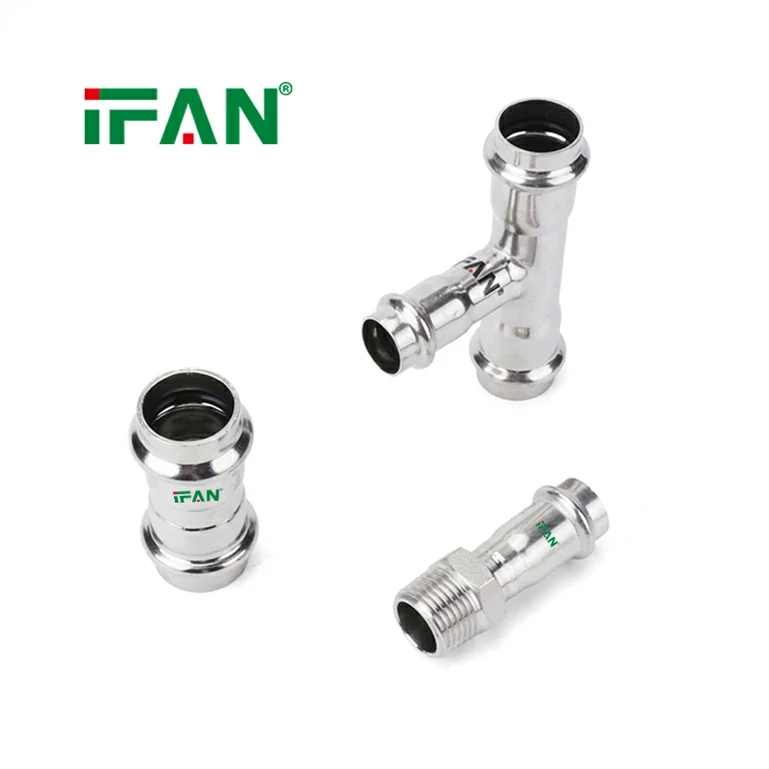
2. Key Advantages
- Speed: Installations are up to 70% faster than traditional methods.
- Reliability: Consistent, machine-made joints eliminate skill-dependent variables.
- Safety: No open flames, sparks, or hazardous fumes.
- Cleanliness: No flux, solder, or debris enters the system.
- Versatility: Suitable for wet conditions, confined spaces, and retrofit projects.
- Corrosion Resistance: 316L stainless steel provides excellent durability in aggressive environments.
3. Material Specifications
- Body Material: 304 or 316L stainless steel (food-grade, marine-grade options available).
- Press Sleeve: 300-series stainless steel, integral or separate.
- Seals: EPDM, FKM (Viton), or HNBR O-rings for specific media compatibility.
- Temperature Range: -40°F to 250°F (-40°C to 121°C) for standard seals.
- Pressure Rating: Up to 232 PSI (16 bar) for water systems.
- Standards: NSF/ANSI 61, ISO 15874, ASTM, IAPMO, UPC.
4. System Types & Applications
Press System Compatibility:
- ProPress for Stainless: Specifically designed for stainless steel piping.
- Universal Systems: Some tools adapt to multiple materials (copper, PEX, stainless).
Primary Applications:
- Potable Water Systems: Residential and commercial plumbing.
- Heating Systems: Radiant floor, radiator connections, boiler piping.
- Industrial Process Lines: Chemical, pharmaceutical, food & beverage.
- Marine & Coastal: Saltwater-resistant piping systems.
- Medical Gas: Oxygen, nitrogen, medical air lines (with proper certification).
- Compressed Air: Oil-free compressed air systems.
5. Installation Process
Preparation:
- Begin by cutting the pipe squarely using a dedicated stainless steel tube cutter.
- Next, remove all burrs and thoroughly clean the pipe end.
- Then, verify pipe roundness with a go/no-go gauge.
- Finally, mark the insertion depth on the pipe clearly.
Pressing:
- First, slide the press sleeve onto the pipe if it is not pre-attached.
- After that, insert the pipe fully into the fitting until it bottoms out.
- Then, position the correct jaw size around the sleeve.
- Subsequently, activate the press tool until it completes its cycle (an audible click confirms completion on many tools).
- Lastly, inspect the joint for a uniform 360° indentation.
Testing:
- Start by pressure testing the system at 1.5 times the operating pressure.
- Additionally, perform a visual inspection of all press marks.
- Finally, document the installation thoroughly for warranty compliance.
6. Tool Requirements
Essential Equipment:
- Battery, electric, or manual hydraulic press tool.
- Stainless steel-specific jaw sets (color-coded).
- Calibration gauge for regular tool verification.
- Dedicated pipe cutter and deburring tool.
Investment Range:
- Basic kit: $800–$1,500.
- Professional system: $1,500–$3,000.
- Important: Tools are often brand-specific (e.g., Viega, RIDGID, Geberit).
7. System Comparison
7.1 Versus Soldered Joints:
- Press Advantage: 5x faster, no fire risk, works in occupied buildings.
- Soldering Advantage: Lower material cost, traditional acceptance.
7.2 Versus Threaded Connections:
- Press Advantage: No thread sealant issues, faster installation, better corrosion resistance.
- Threaded Advantage: Reusable fittings, wider availability.
7.3 Versus Grooved Systems:
- Press Advantage: More compact, better for tight spaces.
- Grooved Advantage: Easier disassembly for modifications.
8. Professional Best Practices
Quality Assurance:
- Use manufacturer-recommended tools and jaws only.
- Calibrate tools every 5,000–10,000 presses.
- Maintain detailed installation records.
- Train all installers on proper techniques.
Design Considerations:
- Allow for thermal expansion in long runs.
- Plan access points for future maintenance.
- Consider electrolytic corrosion when connecting to dissimilar metals.
- Follow manufacturer spacing requirements between fittings.
9. Limitations & Considerations
System-Specific Requirements:
- Tools and fittings are generally not interchangeable between manufacturers.
- Higher initial investment in specialized equipment.
- Requires clean, properly prepared pipe ends.
- Some jurisdictions require certified installers.
Application Limitations:
- Not suitable for temperatures above seal ratings.
- Maximum size typically limited to 4″ diameter.
- Requires proper support spacing per engineering specifications.
10. Cost Analysis
Initial Costs:
- Higher per-fitting cost than traditional methods.
- Significant tool investment required.
- Training and certification expenses.
Long-Term Savings:
- Reduced labor costs (60–80% faster installation).
- Minimal callbacks and warranty claims.
- Lower insurance premiums for some applications.
- Extended system lifespan with reduced maintenance.
ROI Timeline:
- Most contractors recover tool costs within 3–6 medium projects.
- High-volume users see continuous productivity gains.
11. Industry Standards
- ISO 15874: Plastics piping systems for hot and cold water installations.
- ASTM A270: Sanitary stainless steel tubing.
- ASSE 1061: Press-connect fittings and joints.
- NSF/ANSI 61: Drinking water system components.
- PED 2014/68/EU: Pressure equipment directive (Europe).
12. Future Trends
Technological Advancements:
- Smart tools with digital connection verification.
- Enhanced battery technology for longer runtime.
- Improved seal materials for broader chemical compatibility.
- Larger diameter systems for industrial applications.
Market Expansion:
- Growing adoption in pharmaceutical and semiconductor industries.
- Increased use in retrofit and renovation projects.
- Expansion into new geographic markets with stricter corrosion standards.
Summary: Stainless steel press fittings represent a significant advancement in piping technology, offering speed, reliability, and corrosion resistance unmatched by traditional methods. While requiring substantial initial investment in proprietary tools, the system delivers exceptional long-term value through labor savings, reduced maintenance, and extended system life. Success depends on proper training, tool maintenance, and adherence to manufacturer specifications. For professionals working with corrosive environments, high-purity systems, or projects demanding rapid installation, stainless steel press systems provide a proven, code-compliant solution that meets the demands of modern construction and industrial applications.
IFAN factory started in 1993. And IFAN has workshop 120000 square meter with 610 staff. IFAN can design and produce all plumbing pipe and fitting include PPR,PVC,CPVC PPSU HDPE PEXA PEXB PERT pipe and fitting ,brass fitting, brass ball valve ,heating system , gas system , sanitary faucets and hose, In the past 30 Years, IFAN has never forgotten his mission-To protect health and safety. And IFAN factory use best materials to produce high quality pipe and fittings with automatic production line and high tech quality control machines. The most important,IFAN can guarantee that all pipes and fittings manufactured byIFAN are qualified. More information pls feel free contact us Whatsapp.