Comprehensive Guide to PEX Press Fittings: Installation, Benefits EN 15874
Description
Introduction to PEX Press Fittings
PEX press fittings are engineered for use with PEX-a, PEX-b, or PEX-c pipes, depending on the fitting’s compatibility. Unlike soldered copper or PVC fittings, press fittings require no open flames, glues, or specialized skills, making them ideal for DIY enthusiasts and professionals alike. Their popularity stems from their speed, durability, and adaptability to various plumbing systems.
2. Key Features and Advantages
Quick and Easy Installation: A press tool can secure a fitting in seconds, reducing labor time by up to 50% compared to soldering.
Leak-Proof Performance: The stainless steel ring compresses the PEX pipe tightly, ensuring a seal that withstands pressures up to 200 PSI (depending on the fitting).
No Flame or Chemicals Required: Eliminates fire hazards and toxic fumes associated with soldering or gluing.
Corrosion and Scale Resistance: Unlike metal fittings, PEX press fittings do not rust or scale, maintaining water quality over time.
Reusable in Some Cases: Certain press fittings can be disassembled using a special tool, allowing for adjustments (though reuse is not recommended for critical systems).
3. Types of PEX Press Fittings
Straight Couplings: Used to join two PEX pipes end-to-end.
Elbows (90° and 45°): Redirect piping around corners or obstacles.
Tees and Crosses: Split or merge water flow in multiple directions.
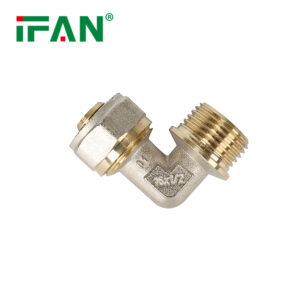
Adapters: Connect PEX pipes to other materials (e.g., copper, CPVC) using threaded or push-fit designs.
Valves: Include shut-off, ball, and check valves for flow control.
4. Applications of PEX Press Fittings
Residential Plumbing: Ideal for water supply lines, radiant heating systems, and hydronic floor heating.
Commercial Buildings: Used in offices, hotels, and hospitals for efficient, low-maintenance plumbing.
Remodeling and Retrofits: Perfect for updating old systems without extensive pipe cutting or soldering.
Outdoor and Underground Installations: Resistant to freezing, UV damage (when protected), and soil chemicals.
5. Installation Process for PEX Press Fittings
Preparation:
Cut the PEX pipe squarely using a rotary or shearing cutter to avoid burrs.
Deburr the pipe end with a reaming tool to ensure a smooth fit.
Assembly:
Slide the stainless steel press ring onto the PEX pipe.
Insert the pipe into the fitting until it reaches the depth mark.
Position the press ring over the fitting’s bead and align it with the press tool’s jaws.
Pressing:
Activate the press tool to compress the ring. Most tools emit an audible “click” when the connection is secure.
Inspect the fitting for proper deformation of the ring (a hexagonal or oval shape indicates a successful press).
Testing:
Perform a pressure test to verify no leaks.
Label the system for future reference.
6. Maintenance and Troubleshooting
Regular Inspections: Check for loose fittings, corrosion (if connecting to metal), or signs of wear.
Avoid Over-Bending: PEX has a bend radius limit; excessive bending can weaken the pipe or fitting.
Prevent UV Exposure: If used outdoors, cover PEX pipes with insulation or UV-resistant tape to avoid degradation.
Address Freezing Risks: Insulate pipes in cold climates to prevent cracking from ice expansion.
7. Comparison with Alternative Fitting Methods
PEX Press vs. Crimping: Crimping requires a specialized tool and crimp rings, while press fittings use a single tool for multiple sizes. Press fittings are generally more reliable due to their visual confirmation of a secure connection.
PEX Press vs. Soldering: Soldering is time-consuming and requires a flame, while press fittings are faster and safer. However, soldered joints may last longer in high-temperature industrial applications.
PEX Press vs. Push-Fit Fittings: Push-fit fittings are even quicker to install but may not withstand high pressures as well as press fittings.
8. Future Innovations in PEX Press Technology
Manufacturers are developing press fittings with integrated sensors for leak detection and smart press tools that log installation data for quality control. Additionally, eco-friendly PEX materials with recycled content are gaining traction in sustainable construction.
Conclusion
PEX press fittings offer a modern, efficient solution for plumbing installations. By following proper installation techniques and regular maintenance, users can enjoy leak-free, long-lasting performance.IFAN factory started in 1993. And IFAN has workshop 120000 square meter with 610 staff. IFAN can design and produce all plumbing pipe and fitting include PPR,PVC,CPVC PPSU HDPE PEXA PEXB PERT pipe and fitting ,brass fitting, brass ball valve ,heating system , gas system , sanitary faucets and hose, In the past 30 Years, IFAN has never forgotten his mission-To protect health and safety. And IFAN factory use best materials to produce high quality pipe and fittings with automatic production line and high tech quality control machines. The most important,IFAN can guarantee that all pipes and fittings manufactured by IFAN are qualified. More information pls feel free contact us Whatsapp.