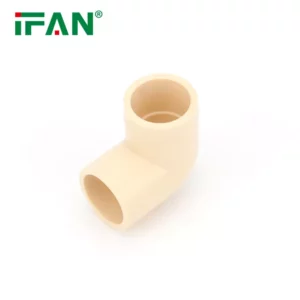
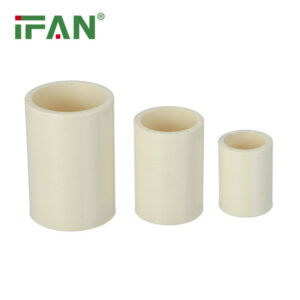
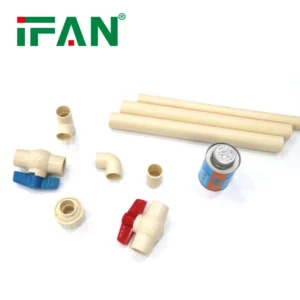
CPVC pipe fitting unions consist of three parts: a nut, a female end, and a male end. When tightened, the nut compresses a gasket between the female and male ends, creating a leak-proof seal. CPVC unions are widely used in residential, commercial, and industrial plumbing for their durability and ease of use.
Key Features and Advantages
Disassembly Capability: Unlike solvent-welded joints, unions allow pipes to be disconnected for maintenance, repairs, or system modifications.
Corrosion and Scale Resistance: CPVC material resists rust and scaling, ensuring long-term performance and water quality.
High Temperature and Pressure Rating: CPVC unions can withstand temperatures up to 200°F (93°C) and pressures up to 100 PSI, making them ideal for hot water systems.
Chemical Resistance: Suitable for systems carrying aggressive chemicals, such as industrial wastewater or pool chlorination solutions.
Lightweight and Easy to Install: CPVC is lighter than metal, simplifying transportation and reducing labor costs.
Cost-Effective: Lower material and installation expenses compared to metal alternatives.
3. Types of CPVC Pipe Fitting Unions
Standard Unions: Feature a nut, female end, and male end for connecting two pipes of the same diameter.
Reducing Unions: Have different inlet and outlet sizes (e.g., 1″ to ¾”) to adjust pipe diameters during connections.
Threaded Unions: Include female NPT threads on one or both ends for connecting to threaded valves, pumps, or fixtures.
Lead-Free Unions: Certified for potable water systems, meeting NSF/ANSI 61 and 372 standards.
Double Union Ball Valves: Combine a union with a ball valve for easy flow control and disassembly.
4. Applications of CPVC Pipe Fitting Unions
Residential Plumbing: Used in hot water heaters, filtration systems, and under-sink connections for easy access.
Commercial Buildings: Applied in offices, hotels, and schools for scalable, low-maintenance plumbing.
Industrial Systems: Used in chemical processing plants, laboratories, and food manufacturing facilities due to their chemical resistance.
Pool and Spa Plumbing: Resistant to chlorine and other pool chemicals, enabling easy pump or filter replacement.
Irrigation Systems: Allows disconnection of sprinkler heads or valves for winterization or repairs.
5. Installation Process for CPVC Pipe Fitting Unions
Preparation:
Cut the CPVC pipe squarely using a fine-toothed saw or CPVC cutter to avoid burrs.
Deburr the pipe end with a reaming tool to ensure a smooth fit.
Clean the pipe and union interiors with CPVC primer to remove oils and contaminants.
Assembly:
Slide the nut and female end onto the pipe.
Insert the male end into the female end, ensuring the gasket is properly seated.
Tighten the nut by hand, then use a wrench to secure it firmly (avoid overtightening to prevent cracking).
Testing:
Perform a pressure test to verify no leaks.
Label the system for future reference.
6. Maintenance and Troubleshooting
Regular Inspections: Check for loose nuts, cracked gaskets, or signs of chemical degradation.
Replace Gaskets Periodically: Gaskets may harden or degrade over time; replace them if leaks occur.
Avoid UV Exposure: If used outdoors, paint CPVC pipes or cover them with UV-resistant tape to prevent brittleness.
Prevent Freezing Risks: Insulate pipes in cold climates to avoid cracking from ice expansion.
Handle with Care: Avoid dropping or mishandling CPVC unions, as impacts can cause hairline cracks.
7. Comparison with Alternative Union Fittings
CPVC vs. PVC Unions: CPVC is rated for higher temperatures and pressures, making it suitable for hot water systems, while PVC is limited to cold water.
CPVC vs. Brass Unions: Brass is more durable but heavier and more expensive. CPVC is ideal for lightweight, cost-sensitive applications.
CPVC vs. Stainless Steel Unions: Stainless steel is corrosion-resistant but requires welding or threading. CPVC unions are solvent-welded or threaded for easier installation.
8. Future Innovations in CPVC Union Technology
Manufacturers are developing CPVC unions with quick-disconnect mechanisms and antimicrobial gaskets to enhance safety and convenience. Additionally, eco-friendly CPVC formulations with recycled content are gaining traction in sustainable construction.
Conclusion
CPVC pipe fitting unions offer a flexible, cost-effective solution for connecting and disconnecting CPVC pipes in plumbing systems. By following proper installation techniques and regular maintenance, users can enjoy leak-free, long-lasting performance.IFAN factory started in 1993. And IFAN has workshop 120000 square meter with 610 staff. IFAN can design and produce all plumbing pipe and fitting include PPR,PVC,CPVC PPSU HDPE PEXA PEXB PERT pipe and fitting ,brass fitting, brass ball valve ,heating system , gas system , sanitary faucets and hose, In the past 30 Years, IFAN has never forgotten his mission-To protect health and safety. And IFAN factory use best materials to produce high quality pipe and fittings with automatic production line and high tech quality control machines. The most important,IFAN can guarantee that all pipes and fittings manufactured by IFAN are qualified. More information pls feel free contact us Whatsapp.



 CPVC ASTM2846