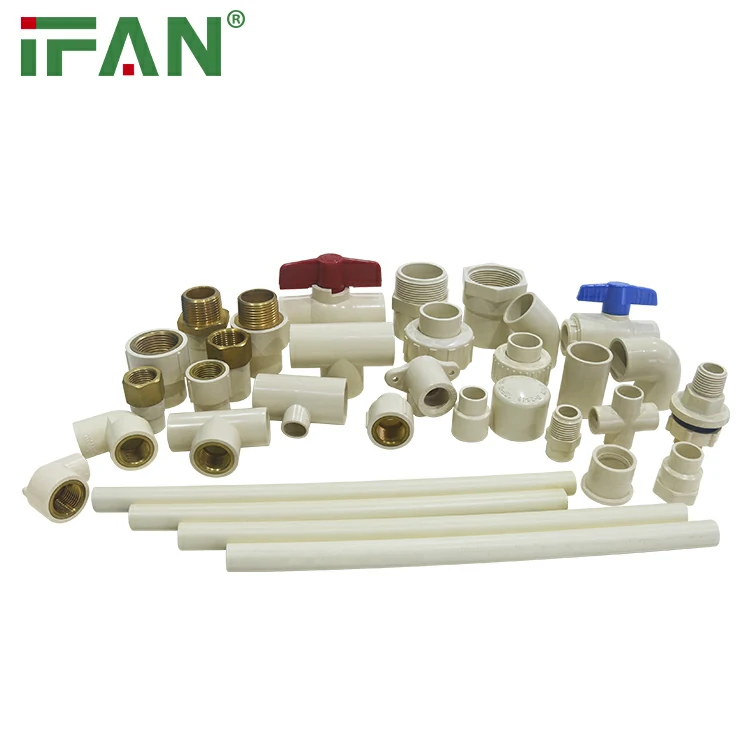


Introduction
A CPVC Tube Fitting is a connector designed for CPVC (Chlorinated Polyvinyl Chloride) pipes, which are widely used in hot water, chemical processing, and industrial fluid transport systems. CPVC’s superior heat resistance (up to 200°F/93°C) and chemical inertness make it ideal for corrosive environments where standard PVC or metal fittings fail. This guide explores types, materials, installation methods, and maintenance to help you leverage CPVC tube fittings effectively.
What Is a CPVC Tube Fitting?
A CPVC Tube Fitting is a mechanical or adhesive-based connector used to join, redirect, or terminate CPVC pipes in plumbing, industrial, and HVAC systems. Unlike PVC, CPVC is chlorinated via a post-production process, enhancing its thermal stability and chemical resistance.Key Features:- Material: CPVC resin (ASTM D1784, Cell Classification 23447-B).
- Pressure Rating: Up to 400 PSI at 73°F (23°C), decreasing with temperature (e.g., 100 PSI at 180°F/82°C).
- Temperature Range: -4°F to 200°F (-20°C to 93°C), suitable for hot water and steam-adjacent systems.
- Certifications: NSF/ANSI 61 (potable water), ASTM F441 (industrial piping), and UL 1821 (fire sprinkler systems).
Types of CPVC Tube Fittings
- Solvent Cement CPVC Fittings
- Design: Smooth ends for chemical welding using CPVC-specific solvent cement (e.g., Oatey All-Purpose CPVC Cement).
- Use Case: Preferred for permanent, leak-proof connections in potable water systems, chemical plants, and fire suppression lines.
- Compression CPVC Fittings
- Design: Features a compression nut, ferrule, and body to create a mechanical seal without glue.
- Use Case: Ideal for DIY repairs, temporary setups, or connecting CPVC to metal pipes (e.g., copper or stainless steel).
- Threaded CPVC Fittings
- Design: Male or female NPT (National Pipe Taper) threads for screw-in connections.
- Use Case: Common in industrial valves, pumps, and instrumentation where disassembly is frequent.
- Push-Fit CPVC Fittings
- Design: Uses O-rings and locking collars for tool-free installation (e.g., SharkBite CPVC connectors).
- Use Case: Best for rapid repairs or retrofits in residential plumbing or lab environments.
- Flange CPVC Fittings
- Design: Flat, circular plates with bolt holes for bolting to matching flanges on pumps or tanks.
- Use Case: Used in large-diameter industrial piping (e.g., wastewater treatment plants).
Advantages of CPVC Tube Fittings
- Heat Resistance CPVC’s chlorine content raises its glass transition temperature (Tg) to 243°F (117°C), compared to PVC’s 176°F (80°C), making it safe for hot water distribution.
- Chemical Inertness CPVC resists acids, alkalis, salts, and solvents (e.g., sulfuric acid, sodium hypochlorite), unlike metal fittings that corrode.
- Cost-Effectiveness CPVC fittings cost 30–50% less than stainless steel or copper alternatives and require no welding or specialized tools for installation.
- Low Thermal Conductivity CPVC’s insulating properties reduce energy loss in hot water lines, lowering heating costs compared to metal pipes.
- Smooth Interior Surface The Haze-Williams C-factor of 150 minimizes friction loss, ensuring efficient fluid flow in industrial hydraulic systems.
Applications of CPVC Tube Fittings
- Hot Water Plumbing Systems Solvent-cemented CPVC fittings transport 180°F (82°C) water in apartments, hotels, and hospitals without scaling or corrosion.
- Chemical Processing Plants Threaded CPVC fittings handle aggressive chemicals like hydrochloric acid (HCl) in storage tanks, reactors, and scrubbers.
- Industrial Wastewater Treatment Flange CPVC fittings connect piping networks for slurry, brine, and effluent transport, resisting abrasion and chemical attack.
- Fire Sprinkler Systems UL-listed CPVC fittings (e.g., BlazeMaster CPVC) are lightweight and corrosion-resistant, reducing maintenance costs in commercial buildings.
- Electroplating & Metal Finishing Compression CPVC fittings resist electrolytic corrosion when transporting acidic or alkaline plating solutions (e.g., chrome, nickel, or zinc baths).
Installation Guide for CPVC Tube Fittings
Select the Right Fitting- Choose ASTM D2846-compliant fittings for potable water or ASTM F441 for industrial use.
- Verify pressure and temperature ratings match system requirements.
- Cut the Pipe
- Use a CPVC pipe cutter or fine-tooth saw to make a square, deburred cut.
- Remove burrs with a reaming tool to prevent solvent cement blockages.
- Dry Fit the Assembly
- For solvent cement fittings, test-fit the pipe into the fitting socket to ensure full insertion (typically 1–1.5 inches).
- Apply Solvent Cement (For Solvent-Weld Fittings)
- Use a medium-bodied, CPVC-specific cement (e.g., Weld-On 724).
- Apply cement to both the pipe and fitting socket using a natural bristle brush.
- Immediately insert the pipe fully and twist ¼ turn to distribute cement evenly.
- Hold the joint for 30 seconds to prevent push-out.
- For threaded fittings, wrap 3–4 layers of PTFE tape clockwise on male threads.
- Hand-tighten, then use two wrenches (one to hold the fitting, one to turn the pipe) for 1–2 additional turns.
- For compression fittings, tighten the nut until snug (avoid over-tightening, which can crack the ferrule).
- Conduct a 2-hour hydrostatic test at 1.5x operating pressure (e.g., 120 PSI for an 80 PSI system).
- Inspect for leaks with a soap solution or ultrasonic leak detector.
Maintenance & Troubleshooting
- Preventive Maintenance:
- For solvent-welded joints, inspect annually for cracks or discoloration (signs of UV degradation).
- For threaded fittings, re-tighten if vibration or thermal cycling loosens connections.
- Common Issues:
- Leaking Solvent Joints: Reapply cement if the joint wasn’t fully seated, or replace the fitting if the pipe was undersized.
- Cracked Threaded Fittings: Replace with schedule 80 CPVC fittings for higher pressure applications.
Related products

- CPVC ASTM2846
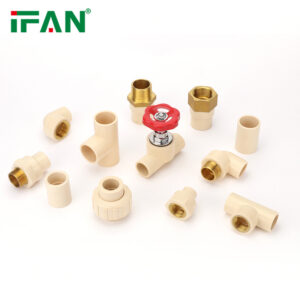
IFAN CPVC Fittings