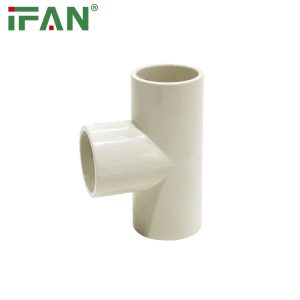
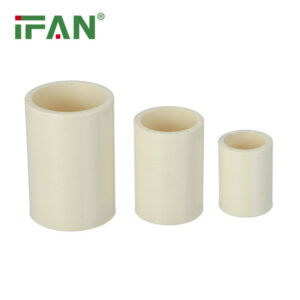
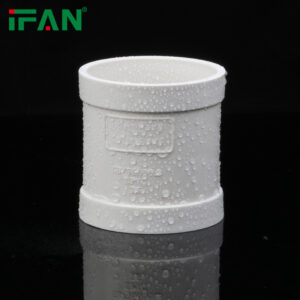
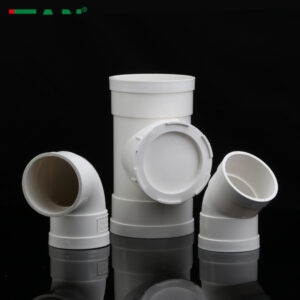
A CPVC Tube Fitting Female Tee (also called a CPVC solvent-weld tee or CPVC socket tee) is a three-way pipe fitting designed to create a 90° branch connection in CPVC piping systems. Unlike male-threaded tees, female tees rely on solvent welding to form permanent, leak-proof joints without threads. Made from chlorinated polyvinyl chloride (CPVC), these fittings resist heat (up to 200°F/93°C) and aggressive chemicals, making them ideal for industrial plumbing, chemical processing, and fire protection systems. This guide covers design features, installation best practices, and key applications to help you select and use CPVC female tees effectively.
What Is a CPVC Tube Fitting Female Tee?
A CPVC Tube Fitting Female Tee is a T-shaped fitting with three solvent-weld sockets (one on each end) for connecting three CPVC pipes at 90° angles. It enables branching off a main pipeline (e.g., adding a drain line or supply line) while maintaining system integrity.Key Features:
Material: CPVC resin (ASTM D1784, Cell Class 23447-B) for thermal and chemical stability.
Pressure Rating: Up to 400 PSI at 73°F (23°C), dropping to 100 PSI at 180°F (82°C) (ASTM D2846).
Temperature Range: -4°F to 200°F (-20°C to 93°C) (suitable for hot water and steam-adjacent systems).
Corrosion Resistance
CPVC’s chlorine content makes it inert to acids, alkalis, and salts, unlike steel tees that rust in hydrochloric acid (HCl) or sodium hydroxide (NaOH).
Thermal Stability
Withstands hot water (up to 200°F) and high-temperature industrial fluids, outperforming PVC female tees (limited to 140°F).
Leak-Proof Joints
Solvent-welding creates a homogeneous bond, eliminating thread leakage risks in chemical storage or high-pressure systems.
Smooth Flow Path
The T-shaped design minimizes pressure drops compared to sharp-angle connections, making it ideal for high-flow applications like water treatment plants.
Cost Efficiency
CPVC female tees cost 30–50% less than stainless steel or brass alternatives and require no specialized tools beyond basic solvent-welding equipment.
Types of CPVC Tube Fitting Female Tees
Standard CPVC Female Tee
Design: Three solvent-weld sockets for branching a main pipeline (e.g., 1″ CPVC female tee connecting three 1″ pipes).
Use Case: Common in residential plumbing, lab drains, and chemical reactors.
Reducing CPVC Female Tee
Design: Two same-sized sockets and one smaller socket (e.g., 1½” x 1½” x 1″) for branching with size reduction.
Use Case: Used in HVAC systems to add a smaller supply line from a main duct.
Street CPVC Female Tee
Design: Two solvent-weld sockets and one male-threaded (NPT) end (e.g., 1″ female socket x 1″ female socket x ¾” male NPT).
Use Case: Connects CPVC pipes to metal valves or pumps in hybrid systems.
Flanged CPVC Female Tee
Design: Combines three solvent-weld sockets with a flange for bolting to tanks or equipment.
Use Case: Ideal for chemical processing vessels requiring disassembly for maintenance.
Heavy-Duty CPVC Female Tee
Design: Thicker walls for higher pressure ratings (up to 600 PSI at 73°F).
Use Case: Used in industrial high-pressure systems like hydraulic fluid transport.
Applications of CPVC Tube Fitting Female Tees
Chemical Processing Plants
Branch sulfuric acid (H₂SO₄) or sodium hypochlorite (bleach) lines from main reactor pipelines with zero corrosion risk.
Potable Water Systems
Create T-branches in municipal water mains or residential plumbing using NSF/ANSI 61-certified female tees.
Fire Sprinkler Systems
UL-listed CPVC female tees (e.g., BlazeMaster® CPVC) provide reliable branch connections in commercial buildings.
Electroplating & Metal Finishing
Resist electrolytic corrosion when handling acidic or alkaline plating solutions (e.g., nickel, chrome, or zinc baths).
HVAC & Chilled Water Systems
Withstand glycol-based coolants without degradation or scaling, ensuring efficient branching in chilled water loops.
Installation Guide for CPVC Tube Fitting Female Tees
Select the Right Female Tee
Choose ASTM F441-compliant fittings for industrial use or NSF/ANSI 61-certified for potable water.
Verify pressure and temperature ratings match system requirements.
Cut the Pipes
Use a CPVC pipe cutter or fine-tooth saw to make square, deburred cuts on all three pipe ends.
Remove burrs with a reaming tool to ensure a smooth fit.
Dry-Fit the Female Tee
Slide the female tee onto all three pipes and check for proper alignment (no gaps or misalignment).
Apply CPVC Primer
Clean the pipe ends and tee interiors with CPVC primer (e.g., Oatey Orange) to soften the surface for bonding.
Apply CPVC Solvent Cement
Use a medium-duty dauber to apply CPVC solvent cement (e.g., Weld-On 725) evenly on all pipe and tee surfaces.
Assemble the Joints
Insert the pipes into the female tee with a ¼-turn motion to distribute cement evenly.
Hold each joint for 30 seconds to prevent push-out during curing.
Cure the Joints
Allow 2 hours for light pressure and 24 hours for full curing before pressure testing.
Avoid disturbing the joints during curing to prevent weak bonds.
Pressure Test
Conduct a 2-hour hydrostatic test at 1.5x operating pressure (e.g., 150 PSI for a 100 PSI system).
Inspect for leaks with a soap solution or ultrasonic leak detector.
Maintenance & Troubleshooting
Preventive Maintenance:
Inspect joints annually for cracks or discoloration (signs of chemical attack or UV degradation).
For chemical systems, verify female tee material compatibility (e.g., CPVC resists most acids but not strong oxidizers like nitric acid).
Common Issues:
Leaking Female Tee: Recut the pipes and reinstall the tee (solvent-welded joints cannot be repaired).
Cracked Tee: Replace immediately if exposed to UV light (CPVC degrades under sunlight without protection).
FAQs
Q1: Can CPVC tube fitting female tees be used for drinking water?
Yes, NSF/ANSI 61-certified CPVC female tees are safe for potable water systems and comply with EPA standards.Q2: What is the difference between a standard and reducing CPVC female tee?
A standard female tee connects three pipes of the same size, while a reducing female tee branches a smaller pipe from two larger pipes (e.g., 1½” x 1½” x 1″).Q3: Can CPVC female tees be glued to PVC pipes?
No, CPVC solvent cement is incompatible with PVC. Use transition fittings or mechanical couplings instead.Q4: How long does a CPVC female tee joint take to cure?
Full curing takes 24 hours, but joints can handle light pressure after 2 hours.Q5: Are CPVC female tees UV-resistant?
CPVC is not UV-stable. For outdoor use, apply UV-resistant paint or install protective sleeves to prevent degradation.
Conclusion
CPVC Tube Fitting Female Tees provide a durable, cost-effective solution for creating branch connections in CPVC piping systems. Their solvent-welded design and chemical resistance outperform PVC and metal alternatives in aggressive environments. For optimal results, select ASTM-compliant female tees, follow proper solvent-welding techniques, and avoid UV exposure. Manufacturers like Harvel Plastics and Spears Manufacturing offer custom fittings for specialized needs.IFAN factory started in 1993. And IFAN has workshop 120000 square meter with 610 staff. IFAN can design and produce all plumbing pipe and fitting include PPR,PVC,CPVC PPSU HDPE PEXA PEXB PERT pipe and fitting ,brass fitting, brass ball valve ,heating system , gas system , sanitary faucets and hose, In the past 30 Years, IFAN has never forgotten his mission-To protect health and safety. And IFAN factory use best materials to produce high quality pipe and fittings with automatic production line and high tech quality control machines. The most important,IFAN can guarantee that all pipes and fittings manufactured by IFAN are qualified. More information pls feel free contact us Whatsapp.