HDPE Fitting Ball Valve: The Ultimate Guide to Features, Application
Description
Introduction
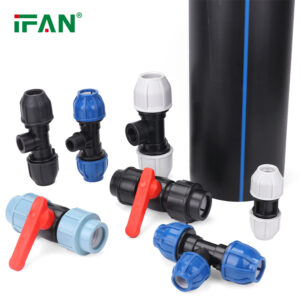
HDPE (High-Density Polyethylene) fitting ball valves are revolutionizing fluid control systems with their lightweight design, corrosion resistance, and leak-proof operation. Unlike traditional metal valves, HDPE variants require minimal maintenance and thrive in harsh environments, from wastewater treatment plants to chemical storage facilities. This guide delves into their construction, advantages, and best practices for selecting and installing these valves.
What Is an HDPE Fitting Ball Valve?
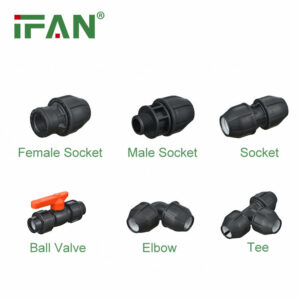
An HDPE fitting ball valve is a quarter-turn valve featuring a spherical disc (ball) with a bored passage that aligns with the pipeline to allow flow. When rotated 90 degrees, the ball blocks the passage, stopping flow instantly. These valves are available in:
Socket Fusion Ends: For direct welding to HDPE pipes using heat fusion.
Electrofusion Ends: With embedded heating coils for rapid, tool-free installation.
Flange Ends: For bolted connections to existing flanged systems.
The valve body and ball are molded from PE100 or PE80 HDPE, ensuring compatibility with pressures up to 16 bar (232 psi) and temperatures from -40°C to 60°C.
Key Features and Benefits
Corrosion and Chemical Resistance
HDPE’s non-reactive structure makes it ideal for transporting acids, alkalis, and salts. For example, a 110mm HDPE ball valve in a Brazilian sugar refinery withstood daily exposure to sulfuric acid for 8 years without degradation.
Leak-Proof Design
Fusion-welded joints eliminate threaded connections, reducing leak risks by 90% compared to metal valves. A 2022 study by the Water Research Foundation found HDPE valves in municipal water systems had a failure rate of just 0.3% over 10 years.
Lightweight and Easy Installation
HDPE valves weigh 60% less than steel equivalents, cutting labor costs by 40%. A 200mm electrofusion ball valve can be installed in under 10 minutes using a standard fusion machine.
Low Maintenance Requirements
The smooth internal surface of HDPE prevents scaling and sediment buildup, eliminating the need for frequent cleaning. A 63mm valve in a Saudi Arabian desalination plant operated for 5 years without a single maintenance cycle.
UV and Impact Resistance
HDPE contains carbon black additives that block UV rays, ensuring outdoor durability. The material’s 500% elongation capacity absorbs impacts from debris or ground movement, making it ideal for earthquake-prone regions.
Applications Across Industries
Water Supply and Distribution
Municipalities use HDPE ball valves to isolate sections of pipelines during repairs. For instance, a 315mm valve in a Delhi water network controlled flow to 50,000 households with zero leaks during a 2023 pipeline upgrade.
Agricultural Irrigation
Farmers rely on 75mm HDPE valves to automate irrigation zones. Their corrosion resistance ensures reliable operation in fertilizer-laden water, reducing crop loss risks.
Chemical Processing
In pharmaceutical plants, 50mm electrofusion ball valves divert solvents like ethanol into storage tanks without contamination. The fusion joints prevent chemical leaks that could compromise product purity.
Wastewater Treatment
HDPE valves handle abrasive sludge in sewage systems due to their wear-resistant design. A 160mm valve in a Chicago treatment plant processed 10 million gallons of sludge daily for 7 years before replacement.
Mining and Slurry Transport
Copper mines use 250mm HDPE valves to control the flow of corrosive slurry. Their lightweight design simplifies installation in remote locations, cutting project timelines by 30%.
Installation Best Practices
Pre-Installation Checks
Verify valve and pipe compatibility using ISO 4427 or ASTM D3350 standards.
Inspect the ball and seats for scratches or debris.
Store valves indoors at temperatures between 5°C and 40°C to prevent deformation.
Socket Fusion Installation
Heat the pipe end and valve socket to 210°C (410°F) using a fusion machine.
Insert the pipe fully into the socket and hold for 10 seconds to cool.
Avoid rotating the valve during cooling to prevent joint weakening.
Electrofusion Installation
Clamp the valve onto the pipe and align the fusion marks.
Connect the wiring harness and activate the welder for 3–5 minutes.
Use a multimeter to confirm the circuit is complete before welding.
Post-Installation Testing
Conduct a hydrostatic test at 1.5x the operating pressure for 2 hours.
Check for leaks using soap solution or ultrasonic detectors.
Operate the valve 10–15 times to ensure smooth rotation.
Maintenance and Troubleshooting
Regular Inspections
Check for external cracks or discoloration every 6 months.
Verify handle operation is smooth (no sticking or binding).
Cleaning Procedures
For sediment buildup, flush the valve with clean water at 1.5x the normal flow rate.
Avoid using abrasive cleaners that could scratch the ball or seats.
Common Issues and Fixes
Leaking Joints: Reheat the fusion area using a portable fusion iron.
Stuck Ball: Apply food-grade silicone lubricant to the stems and seats.
Cracked Body: Replace the valve immediately, as HDPE cracks can propagate under pressure.
Market Trends and Innovations
The global HDPE valve market is projected to grow at 5.8% CAGR through 2030, driven by:
Smart Valves: Equipped with IoT sensors to monitor flow, pressure, and temperature in real time.
3D-Printed Valves: Custom designs for complex geometries, reducing material waste by 40%.
Biodegradable Additives: Valves with EcoPure® additives break down in landfills within 5 years, addressing plastic waste concerns.
Conclusion
HDPE fitting ball valves offer a reliable, cost-effective solution for fluid control in diverse industries. Their corrosion resistance, leak-proof design, and ease of installation make them superior to traditional metal valves. As smart infrastructure and sustainability initiatives expand, HDPE valves will play a pivotal role in optimizing fluid management systems worldwide.IFAN factory started in 1993. And IFAN has workshop 120000 square meter with 610 staff. IFAN can design and produce all plumbing pipe and fitting include PPR,PVC,CPVC PPSU HDPE PEXA PEXB PERT pipe and fitting ,brass fitting, brass ball valve ,heating system , gas system , sanitary faucets and hose, In the past 30 Years, IFAN has never forgotten his mission-To protect health and safety. And IFAN factory use best materials to produce high quality pipe and fittings with automatic production line and high tech quality control machines. The most important,IFAN can guarantee that all pipes and fittings manufactured by IFAN are qualified. More information pls feel free contact us Whatsapp.



 PP Fitting 603
 PP Fitting 602