Whether used in water supply, gas distribution, industrial processing, or irrigation, HDPE (High-Density Polyethylene) fittings provide a cost-effective, corrosion-resistant, and environmentally friendly alternative to traditional metal or PVC fittings.This comprehensive guide explores everything you need to know about HDPE pipe fittings, including their types, benefits, installation methods, applications, and maintenance best practices. Whether you’re a contractor, engineer, or DIY enthusiast, this article will help you make informed decisions for your next piping project.
1. What Are HDPE Pipe Fittings?
HDPE pipe fittings are connectors designed to join HDPE pipes securely while maintaining flow efficiency and structural integrity. Made from high-density polyethylene (HDPE)—a strong, lightweight, and chemically inert thermoplastic—these fittings are resistant to corrosion, impact, and environmental degradation, making them ideal for both underground and above-ground installations.
Key Features of HDPE Pipe Fittings:
✅ Leak-proof fusion joints (no mechanical fasteners or adhesives needed)
✅ High chemical resistance (inert to acids, alkalis, and solvents)
✅ Flexible & durable (withstands ground movement and external forces)
✅ Long service life (50+ years in most applications)
✅ Recyclable & eco-friendly (reduces plastic waste)
2. Types of HDPE Pipe Fittings
HDPE fittings come in various shapes and sizes to accommodate different piping needs. The most common types include:
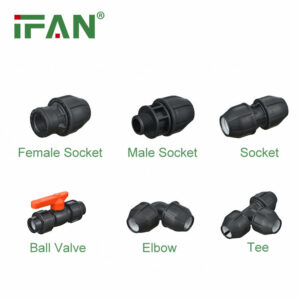
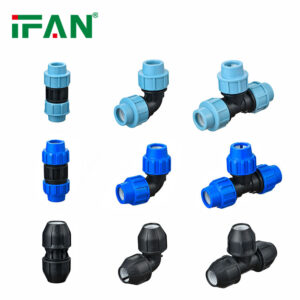
2.1 Elbows (90°, 45°, & Custom Angles)
Used to change pipe direction smoothly.
Available in short-radius (SR) and long-radius (LR) variants for different flow requirements.
2.2 Tees (Equal & Reducing Tees)
Equal tees split flow into three identical directions.
Reducing tees connect pipes of different diameters.
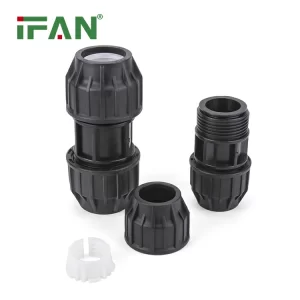
2.3 Couplings & Adapters
Couplings join two pipes of the same diameter.
Adapters connect HDPE pipes to other materials (e.g., PVC, steel).
2.4 Reducers (Concentric & Eccentric)
Concentric reducers maintain a centered flow path.
Eccentric reducers prevent air pockets in horizontal installations.
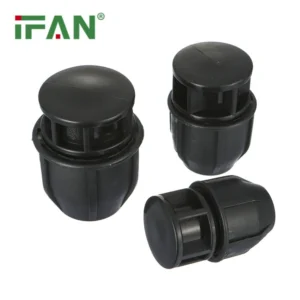
2.5 End Caps & Plugs
End caps seal pipe ends permanently.
Plugs allow temporary closure for testing or maintenance.
2.6 Flanges & Stub Ends
Used for bolted connections in high-pressure systems.
Ideal for large-diameter industrial pipelines.
2.7 Saddle Fittings (Branch Saddles)
Allow branch connections without cutting the main pipe.
Used in water distribution and irrigation systems.
3. Advantages of Using HDPE Pipe Fittings
3.1 Superior Leak Resistance
Unlike threaded or glued fittings, HDPE fittings rely on fusion welding (socket or butt fusion) to create monolithic, seamless joints that prevent leaks even under high pressure or vibration.
3.2 Corrosion & Chemical Resistance
HDPE is inert to most chemicals, making fittings ideal for:
Wastewater treatment (resistant to chlorine, acids, and alkalis)
Agricultural irrigation (withstands fertilizers and pesticides)
Industrial piping (handles solvents, oils, and hydrocarbons)
3.3 Flexibility & Impact Resistance
Withstands ground movement (earthquakes, settling) without cracking.
Resists impact damage (from rocks, machinery, or accidental strikes).
3.4 Cost-Effective & Low Maintenance
Lower lifetime costs (no rust, scaling, or frequent replacements).
Faster installation (fusion welding is quicker than mechanical assembly).
Minimal downtime (no need for regular inspections or repairs).
3.5 Environmentally Friendly
100% recyclable (reduces plastic waste in landfills).
Long lifespan (minimizes replacement frequency).
Low energy consumption (fusion welding requires minimal power).
4. Installation Methods for HDPE Pipe Fittings
Proper installation ensures optimal performance and longevity. The two most common methods are:
4.1 Socket Fusion Welding (Best for Small Diameters ≤ 110mm)
Heating the fitting socket and pipe end (using a socket fusion machine).
Inserting the heated pipe into the socket under controlled pressure.
Allowing the joint to cool (forming a permanent, leak-proof bond).
Advantages:
✔ Fast & reliable for small-scale projects.
✔ No need for specialized equipment beyond a fusion machine.
4.2 Butt Fusion Welding (Preferred for Large Diameters ≥ 110mm)
Heating the ends of two pipes and the fitting (using a butt fusion machine).
Pressing the heated surfaces together (creating a single, continuous piece).
Cooling under pressure (ensuring a strong, homogeneous joint).
Advantages:
✔ Ideal for high-pressure industrial and municipal pipelines.
✔ Creates stronger joints than socket fusion for large diameters.
4.3 Electrofusion Welding (For Complex or Pre-Fitted Systems)
Uses embedded heating coils in the fitting to melt the HDPE.
Requires a specialized electrofusion machine for precise control.
Best for tight spaces or pre-assembled piping networks.
5. Best Applications for HDPE Pipe Fittings
HDPE fittings are versatile and used in:
5.1 Water Supply & Distribution
Municipal water mains (leak-proof connections for neighborhood networks).
Residential plumbing (hot/cold water lines, underfloor heating).
Agricultural irrigation (redirecting water flow efficiently).
5.2 Gas & Oil Pipelines
Natural gas distribution (safe, corrosion-resistant bends).
Oilfield applications (slurry transport, chemical injection lines).
IFAN factory started in 1993. And IFAN has workshop 120000 square meter with 610 staff. IFAN can design and produce all plumbing pipe and fitting include PPR,PVC,CPVC PPSU HDPE PEXA PEXB PERT pipe and fitting ,brass fitting, brass ball valve ,heating system , gas system , sanitary faucets and hose, In the past 30 Years, IFAN has never forgotten his mission-To protect health and safety. And IFAN factory use best materials to produce high quality pipe and fittings with automatic production line and high tech quality control machines. The most important,IFAN can guarantee that all pipes and fittings manufactured byIFAN are qualified. More information pls feel free contact us Whatsapp.HDPE Pipe Fitting



 PP Fitting 603