HDPE Pipe Fittings: Types, Applications, and Best Practices
Description
Introduction
High-Density Polyethylene (HDPE) pipe fittings have revolutionized modern piping systems by offering unmatched durability, chemical resistance, and flexibility. Unlike traditional metal or PVC fittings, HDPE components are engineered to withstand harsh environments, reduce maintenance costs, and ensure leak-proof connections. This guide delves into the types, applications, and installation best practices for HDPE pipe fittings, helping engineers, contractors, and project managers make informed decisions.
Types of HDPE Pipe Fittings
HDPE fittings are categorized based on their manufacturing process and connection methods:
1. Butt Fusion Fittings
Butt fusion involves heating the ends of two HDPE pipes or fittings and pressing them together to form a monolithic joint. This method creates a seamless connection with strength equivalent to the pipe itself, making it ideal for high-pressure applications like gas distribution and industrial fluid handling.
Standards: Compliant with ASTM D3261 for molded fittings and PE4710 material designation for pressure ratings.
Applications: Mainlines, buried pipelines, and systems requiring permanent, leak-free joints.
2. Electrofusion Fittings
Electrofusion fittings incorporate embedded heating coils that melt the HDPE material when an electric current passes through them. This method ensures precise alignment and is suitable for connecting pipes in tight spaces or complex configurations.
Advantages: Quick installation, minimal skill required, and compatibility with pipes of varying diameters.
Use Cases: Repairs, small-scale installations, and connecting pipes to valves or meters.
3. Mechanical Fittings
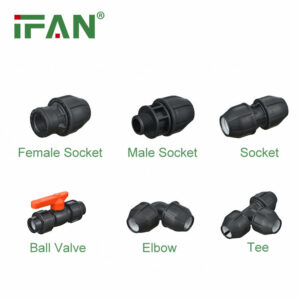
Mechanical fittings use bolts, clamps, or compression rings to join pipes without heat. These include flanged adapters, couplings, and transition fittings.
Key Considerations: Must match the pipe’s pressure rating and OD size. Self-restraining designs with serrated teeth or grippers are recommended for high-stress applications.
Applications: Temporary setups, retrofitting, or connecting HDPE pipes to other materials like PVC or steel.
4. Compression Fittings
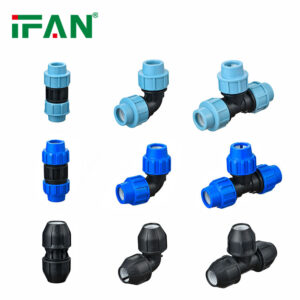
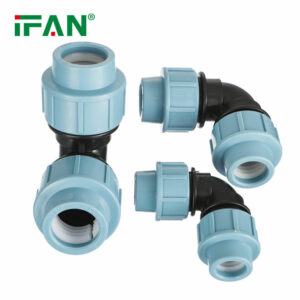
Compression fittings use a nut and ring to create a seal by compressing the pipe against the fitting. They are easy to install and disassemble, making them ideal for low-pressure systems.
Limitations: Not suitable for high-temperature or high-pressure environments.
Applications of HDPE Pipe Fittings
HDPE fittings are versatile and used across industries:
1. Water Supply Systems
HDPE’s corrosion resistance and longevity make it ideal for municipal water distribution, agricultural irrigation, and potable water networks.
Example: A 2023 study highlighted HDPE’s role in reducing water loss in drought-prone regions due to its leak-proof joints.
2. Gas Distribution
HDPE fittings are widely used for natural gas and propane pipelines due to their resistance to stress cracking and chemical degradation.
Safety Standard: Fittings must comply with ASTM F1056 for electrofusion and ASTM D2513 for thermoplastic gas pipes.
3. Industrial Applications
Chemical processing plants, power stations, and mining operations rely on HDPE fittings for transporting slurries, acids, and wastewater.
Benefit: HDPE’s abrasion resistance extends pipeline lifespan in abrasive environments.
4. Mining and Slurry Transport
HDPE’s toughness and chemical stability make it suitable for mining operations, where pipes handle corrosive leachates and abrasive slurries.
Best Practices for Installation
Proper installation is critical to maximizing HDPE fittings’ performance:
1. Size Matching
Always match the fitting’s OD (outer diameter) to the pipe’s OD. Using incorrect sizes leads to leaks or joint failures.
2. Temperature Control
Fusion Process: Avoid rain, wind, or temperatures below 0°C during butt or electrofusion. Use tents or heated enclosures if necessary.
Pipe Handling: Ensure pipes are at ambient soil temperature before backfilling to prevent thermal stress.
3. Cleanliness
Remove dirt, moisture, or debris from pipe ends and fitting surfaces before joining.
Use qualified personnel and calibrated equipment to avoid contamination.
4. Future-Proofing
Account for potential expansion by oversizing pipes slightly. While initial costs may be higher, this avoids costly upgrades later.
Common Mistakes to Avoid
Ignoring Flow Rate Requirements: Undersizing pipes leads to pressure drops and reduced efficiency.
Using Unapproved Fittings: Contractor-fabricated fittings must be engineer-approved to ensure compliance with standards.
Neglecting UV Protection: HDPE pipes must contain carbon black (≥2%) to prevent UV degradation.
Conclusion
HDPE pipe fittings offer a durable, cost-effective, and eco-friendly solution for modern piping systems. By understanding their types, applications, and installation best practices, stakeholders can ensure reliable performance across industries. Always adhere to standards like ASTM D3261 and PE4710 to guarantee safety and longevity.IFAN factory started in 1993. And IFAN has workshop 120000 square meter with 610 staff. IFAN can design and produce all plumbing pipe and fitting include PPR,PVC,CPVC PPSU HDPE PEXA PEXB PERT pipe and fitting ,brass fitting, brass ball valve ,heating system , gas system , sanitary faucets and hose, In the past 30 Years, IFAN has never forgotten his mission-To protect health and safety. And IFAN factory use best materials to produce high quality pipe and fittings with automatic production line and high tech quality control machines. The most important,IFAN can guarantee that all pipes and fittings manufactured byIFAN are qualified. More information pls feel free contact us Whatsapp.



 PP Fitting 603
 PP&PE
PP&PE