

PE Pipe: A Comprehensive Guide to Polyethylene Piping Systems
1. Introduction to PE Pipes
Polyethylene (PE) pipes are a type of thermoplastic piping system widely used for transporting water, gas, chemicals, and wastewater. Known for their flexibility, durability, and corrosion resistance, PE pipes have become a preferred choice in residential, commercial, and industrial applications.
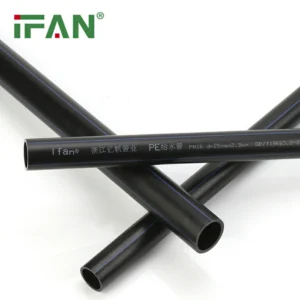
Unlike traditional metal pipes (steel, copper), PE pipes are lightweight, easy to install, and resistant to chemical degradation, making them ideal for underground and above-ground installations.
2. Types of PE Pipes
PE pipes are classified based on their density and molecular structure, which determine their properties and applications:
A. HDPE (High-Density Polyethylene) Pipes
- Characteristics: High strength, rigid, and resistant to impact and abrasion.
- Applications:
- Water supply (potable and non-potable)
- Sewage and drainage systems
- Industrial chemical transport
- Mining and dredging operations
B. MDPE (Medium-Density Polyethylene) Pipes
- Characteristics: More flexible than HDPE but stronger than LDPE.
- Applications:
- Gas distribution networks
- Underground water mains
- Irrigation systems
C. LDPE (Low-Density Polyethylene) Pipes
- Characteristics: Highly flexible, soft, and impact-resistant.
- Applications:
- Low-pressure irrigation
- Agricultural spray systems
- Cable protection conduits
3. Key Advantages of PE Pipes
A. Corrosion & Chemical Resistance
- PE pipes are immune to rust, scale, and chemical corrosion, making them ideal for transporting aggressive fluids.
B. Flexibility & Ease of Installation
- Unlike rigid pipes, PE pipes can be bent without cracking, reducing the need for multiple fittings.
- Lightweight design simplifies handling and reduces transportation costs.
C. Long Service Life
- PE pipes can last 50+ years with proper installation, outperforming metal and PVC alternatives.
D. Leak-Free Joints
- Heat fusion welding creates seamless, monolithic joints that prevent leaks.
E. Environmentally Friendly
- PE pipes are 100% recyclable, reducing environmental impact.
4. Manufacturing Process of PE Pipes
PE pipes are produced through extrusion, a process where polyethylene resin is melted and formed into a continuous tube. Key steps include:
- Resin Selection: High-quality PE granules are chosen based on density (HDPE, MDPE, LDPE).
- Extrusion: The resin is heated and forced through a die to form a pipe shape.
- Cooling & Sizing: The pipe is cooled and sized to precise dimensions.
- Cutting & Quality Control: Pipes are cut to length and inspected for defects.
5. Applications of PE Pipes
A. Water Supply & Distribution
- Potable water systems: Safe for drinking water due to non-toxic material.
- Non-potable water: Used in irrigation, fire protection, and industrial cooling.
B. Gas Distribution
- Natural gas & LPG transport: MDPE pipes are widely used in residential and commercial gas networks.
C. Sewage & Drainage
- Stormwater management: HDPE pipes handle high flow rates with minimal clogging.
- Sewer systems: Resistant to chemical and biological degradation.
D. Industrial Applications
- Chemical transport: PE pipes resist acids, alkalis, and solvents.
- Slurry pipelines: Used in mining and dredging for abrasive fluid transport.
E. Telecommunications & Electrical
- Cable ducting: Protects underground cables from moisture and damage.
6. Installation Methods for PE Pipes
A. Heat Fusion Welding (Butt & Electrofusion)
- Butt Fusion: Joins pipes end-to-end by melting and fusing them under heat.
- Electrofusion: Uses embedded heating coils to create strong joints.
B. Mechanical Joints (Compression & Flanged)
- Compression fittings: Quick and easy for low-pressure applications.
- Flanged connections: Used for high-pressure or large-diameter pipes.
C. Trenchless Installation (HDD & Directional Drilling)
- Horizontal Directional Drilling (HDD): Minimizes excavation, ideal for urban areas.
7. Standards & Certifications
PE pipes must comply with international standards to ensure safety and performance:
- ISO 4427: Global standard for PE water pipes.
- ASTM D3350: Specifies material properties for PE pipes.
- EN 12201: European standard for water supply pipes.
- NSF/ANSI 61: Certifies pipes for potable water use.
8. Common Issues & Solutions
| Issue | Cause | Solution |
|---|---|---|
| Leakage at Joints | Poor welding technique | Retrain installers or use electrofusion. |
| Pipe Cracking | Over-bending or impact | Use proper bending radii or protective sleeves. |
| UV Degradation | Prolonged sun exposure | Use UV-stabilized PE or coatings. |
| Low Flow Capacity | Incorrect pipe sizing | Recalculate flow requirements and upgrade diameter. |
9. Case Study: Municipal Water Supply Project
Challenge: A city needed to replace aging metal water mains prone to corrosion and leaks.
Solution: Installed HDPE pipes with electrofusion joints for a leak-proof, long-lasting system.
Results:
- 60% reduction in leaks within the first year.
- 30% lower installation costs compared to steel pipes.
- 25-year warranty ensuring long-term reliability.
10. Future Trends in PE Pipe Technology
- Smart PE Pipes: Integration of sensors for real-time leak detection.
- Nano-Composite PE: Enhanced strength and durability.
- Sustainable Production: Use of bio-based PE resins to reduce carbon footprint.
11. Conclusion
PE pipes are versatile, durable, and cost-effective, making them a leading choice for modern piping systems. Their resistance to corrosion, flexibility, and ease of installation ensure reliable performance in water, gas, and industrial applications.
IFAN factory started in 1993. And IFAN has workshop 120000 square meter with 610 staff. IFAN can design and produce all plumbing pipe and fitting include PPR,PVC,CPVC PPSU HDPE PEXA PEXB PERT pipe and fitting ,brass fitting, brass ball valve ,heating system , gas system , sanitary faucets and hose, In the past 30 Years, IFAN has never forgotten his mission-To protect health and safety. And IFAN factory use best materials to produce high quality pipe and fittings with automatic production line and high tech quality control machines. The most important,IFAN can guarantee that all pipes and fittings manufactured by IFAN are qualified. More information pls feel free contact us Whatsapp.
Related products

- PP Fitting 601
PP Fittings
- PP Fitting 601
PP Fittings 601
- PP Fitting 601
PP female socket