

Brass Ball Valves: Complete Technical and Application Guide
1. Product Overview
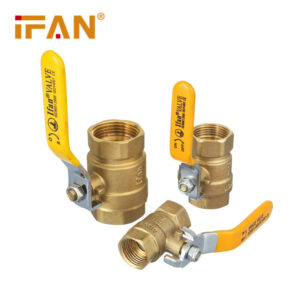
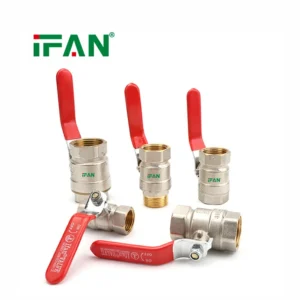
Brass ball valves are quarter-turn flow control devices featuring a rotating spherical disc (the “ball”) with a through-hole. When aligned with the flow direction, the valve is open; a 90-degree turn closes it. Manufactured from corrosion-resistant brass alloys, these valves provide reliable shutoff service across plumbing, heating, gas, and industrial applications.
2. Material Composition and Standards
Body Material: Dezincification-resistant brass (DZR/CuZn), lead-free per NSF/ANSI 61 & 372.
Ball & Stem: Typically chrome-plated brass or stainless steel for durability.
Seats & Seals: PTFE (standard), reinforced PTFE, or Viton® for high-temperature applications.
Pressure Ratings: Common classes: 150 WOG (Water, Oil, Gas), 200 WOG, 300 WOG.
Temperature Range: Standard: -20°F to 400°F (-29°C to 204°C); high-temp seals extend range.
End Connections: NPT (National Pipe Thread), BSP (British Standard Pipe), union ends, or solder.
Certifications: NSF/ANSI 61/372, ASME B16.34, API 607/6FA (fire-safe).
3. Key Advantages
Reliable Shutoff: Bubble-tight sealing with low operating torque.
Corrosion Resistance: Suitable for water, oils, fuels, and many chemicals.
Long Service Life: Robust construction ensures decades of operation.
Quick Operation: Quarter-turn design allows for fast open/close.
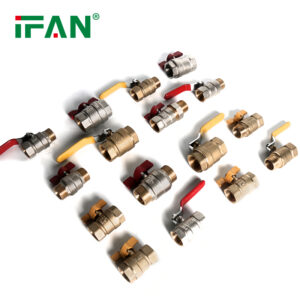
Versatility: Available in multiple configurations for diverse applications.
Maintenance-Friendly: Many designs allow for in-line repair or seal replacement.
4. Types and Configurations
Standard Two-Piece: Most common; economical with threaded ends.
Three-Piece Design: Allows center-section removal for easy maintenance.
Full Port (Full Bore): Ball orifice matches pipe ID, minimizing pressure drop.
Standard Port: Compact, cost-effective for general use.
Multi-Port (3-Way, 4-Way): For flow diversion, mixing, or bypass applications.
Actuated Valves: Automated with electric, pneumatic, or hydraulic actuators.
5. Application Areas
Plumbing Systems:
Main water supply shutoffs
Water heater isolation
Fixture and appliance supply control
Heating and HVAC:
Boiler and radiator isolation
Hydronic system zone valves
Chilled water and condenser water control
Gas Service:
Natural gas and propane lines (use valves marked for gas service)
Meter and appliance shutoffs
Industrial and Process:
Compressed air systems
Process water and cooling lines
Fuel oil and lubricant handling
Chemical processing (verify compatibility)
6. Selection Criteria
Technical Specifications:
Pressure/Temperature: Match or exceed system operating conditions.
Flow Requirements: Full-port for minimal restriction; standard-port for cost savings.
Media Compatibility: Ensure brass and seal materials are suitable for the fluid.
Connection Type: Select NPT, BSP, solder, or union based on existing piping.
Quality and Certification:
Look for NSF/ANSI 61 certification for potable water.
Choose fire-safe certified valves (API 607/6FA) for hazardous applications.
Verify manufacturer testing and warranty.
7. Installation Best Practices
Preparation:
Ensure pipe threads are clean and undamaged.
Apply appropriate thread sealant (tape or compound) to male threads only.
Support piping adjacent to the valve to prevent stress.
Installation Steps:
Hand-tighten the valve to ensure proper thread engagement.
Use two wrenches—one to hold the valve body, another to tighten the fitting—to avoid distortion.
Cycle the valve several times to ensure free operation before system pressurization.
Gas-Specific Installation:
Use only valves clearly marked for gas service.
Follow local gas code requirements for placement and accessibility.
Test for leaks with approved methods after installation.
8. Maintenance and Troubleshooting
Routine Maintenance:
Operate valves periodically if normally left in one position.
Inspect for external corrosion or mineral deposits.
Check for minor leaks at stem or body seals during system maintenance.
Common Issues and Solutions:
Leakage at Stem: Tighten the stem packing gland nut slightly.
Leakage through Seat: May indicate worn seals or debris; requires disassembly or replacement.
Stiff Operation: Can result from sediment buildup or corrosion; exercise carefully or service.
Handle Misalignment: Reposition handle to match ball position.
Replacement Indicators:
Visible cracking or material degradation
Inability to achieve complete shutoff
Excessive operating torque required
Physical damage to valve body or connections
9. Professional Recommendations
Install with accessible orientation for handle’s full 90-degree sweep.
In critical systems, install unions before and after the valve to facilitate future service.
Label all valves clearly for easy identification during maintenance.
For corrosive environments, consider alternative materials (stainless steel, alloy).
Keep records of valve specifications and installation dates.
10. Cost Considerations and Value
Initial Cost: Competitive with other quality valve materials.
Installation Cost: Generally lower than gate or globe valves due to simpler installation.
Lifetime Cost: Lower than many alternatives due to minimal maintenance requirements.
Value Proposition: Excellent balance of performance, durability, and cost for most general-purpose applications.
Summary: Brass ball valves represent a versatile, durable solution for flow control across numerous applications. Their quarter-turn operation, reliable sealing, and corrosion resistance make them suitable for plumbing, heating, gas, and industrial systems. Proper selection based on pressure rating, temperature, media compatibility, and connection type ensures optimal performance and longevity. With minimal maintenance requirements and long service life, brass ball valves provide excellent value for both residential and commercial installations. For applications requiring specific certifications or enhanced durability, consulting with manufacturers or suppliers is recommended to select the most appropriate valve configuration.
IFAN factory started in 1993. And IFAN has workshop 120000 square meter with 610 staff. IFAN can design and produce all plumbing pipe and fitting include PPR,PVC,CPVC PPSU HDPE PEXA PEXB PERT pipe and fitting ,brass fitting, brass ball valve ,heating system , gas system , sanitary faucets and hose, In the past 30 Years, IFAN has never forgotten his mission-To protect health and safety. And IFAN factory use best materials to produce high quality pipe and fittings with automatic production line and high tech quality control machines. The most important,IFAN can guarantee that all pipes and fittings manufactured byIFAN are qualified. More information pls feel free contact us Whatsapp.
Related products
 Brass Valve
Yellow Gas Ball Valve
- Ball Valve
IFAN Brass Ball Valve
- Brass Valve
IFAN Brass Check Valve
 Brass Valve
Gate Valve