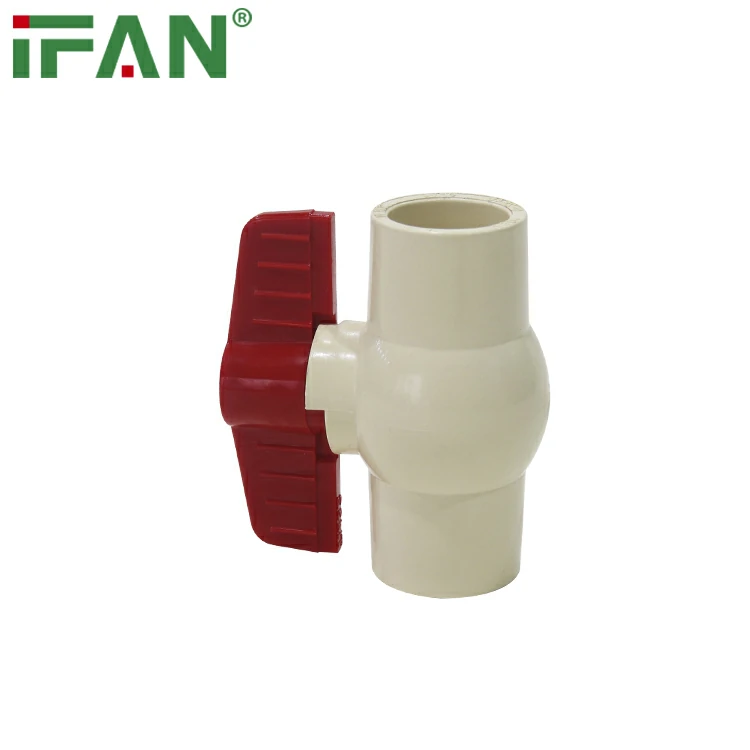
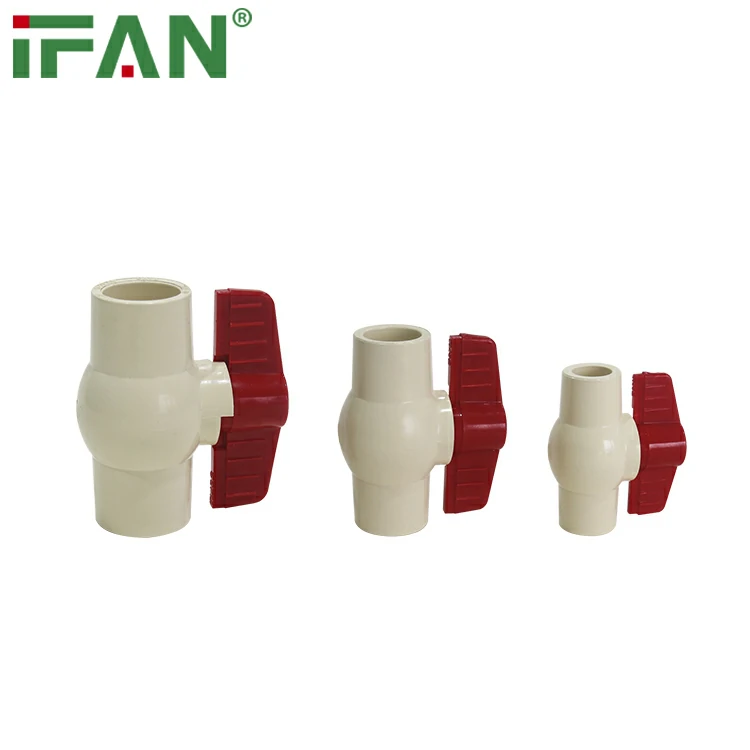
IFAN Water Use Durable ASTM2846 PVC Ball Valves
Description
PVC Ball Valve: Durable Flow Control for Residential and Industrial Applications
Introduction
When it comes to reliable and efficient fluid control, few solutions are as practical and cost-effective as a PVC ball valve. Known for its chemical resistance, affordability, and ease of use, this type of valve is widely used across residential, agricultural, and industrial piping systems. Whether you’re installing a home irrigation system or managing chemical flow in a factory, a PVC ball valve offers dependable performance.
What Is a PVC Ball Valve?
A PVC ball valve is a shut-off valve that controls the flow of liquids through a pipeline using a rotating ball with a central bore. When the bore aligns with the pipe, fluid flows freely. Turning the handle 90 degrees blocks the passage, stopping the flow completely.
These valves are made from polyvinyl chloride (PVC), a lightweight yet durable thermoplastic. This makes them an ideal alternative to metal valves in non-pressurized or low-pressure systems that do not require heat resistance.
Key Benefits of PVC Ball Valves
1. Corrosion and Chemical Resistance
PVC material naturally resists most acids, bases, and salts. This quality allows PVC ball valves to operate in harsh chemical environments where metal valves would corrode or degrade over time.
2. Lightweight and Easy to Install
Compared to brass or stainless-steel valves, PVC valves are significantly lighter. This makes transportation and installation faster and more convenient, especially for DIY applications or large-scale systems with long piping runs.
3. Affordable and Cost-Effective
PVC is inexpensive to produce, which means PVC ball valves provide excellent performance without high costs. This makes them a go-to choice for systems that require many valves or regular replacements.
4. Smooth Operation
The internal ball mechanism ensures fast, quarter-turn control. With a simple lever handle, users can easily open or close the valve without tools or significant force. This is particularly beneficial in residential gardens, fish ponds, or greenhouse irrigation systems.
Common Applications
A PVC ball valve serves a broad range of industries and settings:
Residential plumbing: For cold-water piping, garden irrigation, or swimming pools
Agriculture: For irrigation lines, fertilizer systems, and livestock watering
Chemical handling: Where corrosion resistance is crucial
Aquaculture and water treatment plants: For managing clean and waste water systems
HVAC systems: In low-pressure, non-heated fluid loops
Its versatility makes it an excellent component in any non-metallic piping network.
Types of PVC Ball Valves
There are several variations to consider based on your system’s needs:
Single Union and Double Union Valves: Double union models allow for easier maintenance and removal without cutting the pipe.
Threaded or Socket End Connections: Depending on whether the system uses solvent cement or threaded fittings.
Full-Port vs. Standard-Port Valves: Full-port valves offer unrestricted flow, while standard-port designs are more compact.
Selecting the right combination improves system efficiency and simplifies serviceability.
Installation Tips
For proper installation and leak-free performance:
Use compatible PVC primer and cement for solvent-welded models.
Clean and dry all surfaces before applying adhesive.
Avoid overtightening threaded valves, as this can cause cracks.
Install in the closed position to protect the ball mechanism from glue exposure.
Although easy to install, following these steps ensures long-term durability and performance.
PVC ball valve Maintenance and Lifespan
PVC valves are virtually maintenance-free, but occasional inspection is wise:
Check for cracks or leaks, especially in outdoor or high-pressure systems.
Avoid prolonged exposure to UV rays, as sunlight can degrade PVC over time. Using UV-resistant covers or paints can extend lifespan.
Operate the valve periodically to prevent sticking and ensure smooth movement.
With basic care, a PVC ball valve can function reliably for over a decade.
Conclusion
Whether you’re managing a small garden or operating an industrial process, the PVC ball valve offers an efficient, durable, and affordable solution for fluid control. Its resistance to chemicals, ease of installation, and wide availability make it a top choice for engineers, plumbers, and DIYers alike.
IFAN factory started in 1993. And IFAN has workshop 120000 square meter with 610 staff. IFAN can design and produce all plumbing pipe and fitting include PPR,PVC,CPVC PPSU HDPE PEXA PEXB PERT pipe and fitting ,brass fitting, brass ball valve ,heating system , gas system , sanitary faucets and hose, In the past 30 Years, IFAN has never forgotten his mission-To protect health and safety. And IFAN factory use best materials to produce high quality pipe and fittings with automatic production line and high tech quality control machines. The most important,IFAN can guarantee that all pipes and fittings manufactured by IFAN are qualified. More information pls feel free contact us Whatsapp.
Related products