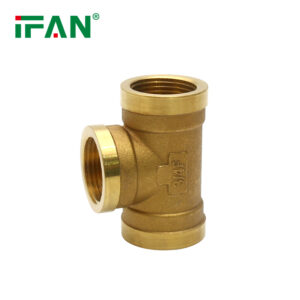
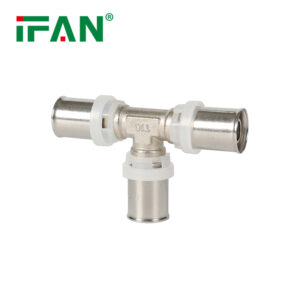
PEX press fitting tees have revolutionized plumbing systems by enabling fast, flameless branching of water supply lines. With the global PEX market projected to reach $12.3 billion by 2027, understanding tee technology is essential for contractors and homeowners alike. This guide explores tee configurations, material science, and professional installation techniques to ensure 50+ years of reliable service in both hot and cold water applications.
How PEX Press Fitting Tees Work
Core Mechanics
Press tees create permanent three-way connections through mechanical compression:
Pipe Insertion: PEX tubing slides into all three ports until contacting internal stops
Pressing Action: A calibrated jaw tool simultaneously compresses stainless steel rings on all ports
Seal Formation: Dual O-rings (primary + backup) in each port deform to fill microscopic gaps
Key Advantages Over Traditional Methods:
Time Efficiency: Installs 3x faster than soldering (45 seconds vs. 2.5 minutes per joint)
Safety: Eliminates fire hazards and toxic flux fumes
Vibration Resistance: Withstands 10G dynamic loads without loosening
Visual Verification: Press marks provide instant quality control
Tee Types & Their Applications
1. Standard Straight Tees
Best For: Basic 90° branching in water supply lines
Features:
1/2″ to 2″ diameter range
Equal port sizes (e.g., 1″ x 1″ x 1″)
2.5x thicker wall at compression zones vs. crimp tees
Application Example: Creating bathroom group branches from a main supply line
2. Reducing Tees
Best For: Transitioning between different pipe diameters in a single fitting
Features:
40% smaller profile than using separate reducers
Precision-machined transitions (1:12 slope)
Available in configurations like 1″ x 3/4″ x 1″
Application Example: Connecting a 1″ main to 3/4″ branch lines for sinks
3. Threaded Tees
Best For: Direct connections to fixtures without additional adapters
Features:
Male NPT threads on one port (typically the bottom)
Pre-applied Teflon tape on threads
45° angled versions for tight spaces
Application Example: Attaching water heater drain valves to PEX manifolds
4. Multi-Port Tees
Best For: Complex branching requiring more than three connections
Features:
4-way and 5-way configurations
Integrated flow dividers for balanced distribution
Press-to-press compatibility (no threaded transitions needed)
Application Example: Central manifolds in large-scale radiant heating systems
Installation Best Practices
Step-by-Step Protocol
Pipe Preparation:
Cut PEX squarely using a rotary cutter (avoid ratchet-style tools)
Deburr inside diameters with a double-edge reamer
Mark insertion depth (typically 1.2″ for 1″ tees)
Component Assembly:
Slide stainless steel pressing rings onto all pipes
Insert pipes into tee ports until they reach internal stops
Position O-rings in each port’s groove (if not pre-installed)
Pressing Process:
Select correct jaw size (must match all pipe diameters)
Align jaws perpendicular to pipes
Apply full pressure until tool clicks (5-7 seconds per port)
Pro Tip: For hot water applications (>180°F), use silicone O-rings instead of standard EPDM. This reduces compression set by 68% over 10-year service life.
Common Mistakes to Avoid
Incomplete Pressing: Results in weak joints that leak under pressure. Solution: Use a go/no-go gauge to verify full compression on all ports.
Mixed Materials: Combining PEX-A with PEX-B tees causes inconsistent expansion rates. Always match pipe and fitting types.
Contaminated Seals: Dust on O-rings reduces sealing efficiency by 50%. Clean components with 99% isopropyl alcohol before assembly.
Over-Insertion: Exceeding marked depth deforms O-rings. Use depth stops on cutting tools for consistency.
Conclusion
PEX press fitting tees represent the pinnacle of modern plumbing branching solutions, combining speed, safety, and reliability in a single component. By selecting the appropriate tee type and material for each application, professionals can ensure compliance with global standards while optimizing system longevity. As smart building technologies integrate pressure monitoring into fittings, the press tee’s inherent robustness positions it as the future-proof choice for both new constructions and retrofit projects. Staying current with certification updates and material science advancements will be key to maintaining competitive edge in this evolving market.IFAN factory started in 1993. And IFAN has workshop 120000 square meter with 610 staff. IFAN can design and produce all plumbing pipe and fitting include PPR,PVC,CPVC PPSU HDPE PEXA PEXB PERT pipe and fitting ,brass fitting, brass ball valve ,heating system , gas system , sanitary faucets and hose, In the past 30 Years, IFAN has never forgotten his mission-To protect health and safety. And IFAN factory use best materials to produce high quality pipe and fittings with automatic production line and high tech quality control machines. The most important,IFAN can guarantee that all pipes and fittings manufactured byIFAN are qualified. More information pls feel free contact us Whatsapp.



 Brass Fitting