

CPVC Union Fittings: Versatile, Durable, and Easy-to-Install Solutions for Piping Systems
CPVC (Chlorinated Polyvinyl Chloride) union fittings are essential components in modern piping networks, designed to provide a quick-disconnect mechanism for easy assembly, disassembly, and maintenance. These fittings are widely used in residential, commercial, and industrial applications where flexibility, chemical resistance, and high-temperature performance are critical. Below is a detailed exploration of their features, benefits, applications, and installation guidelines.
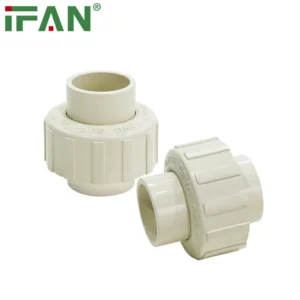
1. Key Features of CPVC Union Fittings
1.1 Material Composition & Properties
- CPVC Polymer: Enhanced with chlorine content (up to 67%), offering superior thermal stability (up to 200°F/93°C) and chemical resistance compared to standard PVC.
- Additives: UV stabilizers, impact modifiers, and lubricants improve durability, weatherability, and processing ease.
- Pressure Rating: Typically 100 PSI at 180°F (6.9 bar at 82°C) for Schedule 40 fittings; higher for Schedule 80 variants.
1.2 Design & Construction
- Three-Piece Assembly:
- Two Threaded Ends: Connect to CPVC pipes or other fittings via solvent cementing or threading.
- Central Nut: Tightens to compress a gasket (usually EPDM or FKM) between the two ends, ensuring a leak-proof seal.
- End Types:
- Socket x Socket (S x S): For solvent cementing with CPVC pipes.
- Threaded x Threaded (T x T): For compatibility with threaded pipes or metal components.
- Hybrid (Socket x Threaded): Combines both connection methods for versatility.
- Sizing Options:
- Copper Tube Size (CTS): Matches copper pipe dimensions (e.g., ½” CTS CPVC union).
- Schedule 40 & Schedule 80: Thicker walls for higher pressure applications.
1.3 Chemical Resistance
CPVC unions resist a wide range of corrosive substances, including:
- Acids: Acetic acid, hydrochloric acid (diluted), phosphoric acid.
- Alkalis: Sodium hydroxide, potassium hydroxide solutions.
- Salts: Seawater, brine.
- Other Chemicals: Alcohols, hydrogen peroxide, and many industrial solvents.
2. Advantages Over Alternative Connection Methods
| Feature | CPVC Union Fittings | CPVC Solvent-Welded Joints | Metal Unions (Steel/Brass) |
|---|---|---|---|
| Installation Speed | Fast (no curing required) | Slow (requires solvent cement) | Moderate (threading needed) |
| Reusability | High (disassemble & reuse) | Low (cemented joints are permanent) | Moderate (prone to wear) |
| Chemical Resistance | Excellent | Excellent | Poor (corrodes easily) |
| Weight | Lightweight | Lightweight | Heavy |
| Cost | Moderate | Low | High (material + labor) |
| Thermal Stability | Up to 200°F | Up to 200°F | Higher (but requires insulation) |
3. Primary Applications
3.1 Residential Plumbing
- Used in hot and cold water distribution systems for easy access to water heaters, filters, and shut-off valves.
- Ideal for under-sink connections, shower valves, and laundry room piping.
3.2 Commercial & Industrial Piping
- HVAC Systems: Facilitates maintenance of chillers, boilers, and cooling towers.
- Chemical Processing: Enables quick disconnection of pumps, valves, and reactors for cleaning or repair.
- Water Treatment Plants: Simplifies filter changes and equipment isolation.
3.3 Pool & Spa Systems
- Resists chlorine and other pool chemicals, ensuring long-term reliability in pump and filter connections.
3.4 Fire Sprinkler Systems
- Allows for easy inspection and replacement of sprinkler heads without cutting pipes.
4. Installation Guidelines
4.1 Pre-Installation Checks
- Verify that pipes and fittings are clean, dry, and free of debris.
- Ensure compatibility with system pressure and temperature ratings.
4.2 Assembly Process
- Apply Lubricant (if needed): Use a silicone-based lubricant on the gasket for smoother tightening.
- Hand-Tighten First: Connect the two ends and thread the nut onto the assembly.
- Wrench-Tighten: Use adjustable wrenches to tighten the nut until snug (avoid over-tightening to prevent gasket damage).
- Pressure Test: Conduct a hydrostatic test at 1.5x the working pressure for 30 minutes to check for leaks.
4.3 Best Practices
- Avoid Cross-Threading: Ensure threads align properly before tightening.
- Use Proper Tools: Adjustable wrenches or strap wrenches prevent damage to the fitting.
- Support Heavy Pipes: Use hangers or clamps to prevent stress on the union.
5. Maintenance & Troubleshooting
5.1 Regular Inspections
- Check for leaks, cracks, or corrosion every 6–12 months.
- Tighten the nut slightly if minor leakage occurs (do not over-tighten).
5.2 Common Issues & Solutions
| Problem | Cause | Solution |
|---|---|---|
| Leaking at Union | Loose nut or damaged gasket | Tighten nut or replace gasket |
| Difficult Disassembly | Over-tightening or corrosion | Apply penetrating oil; use proper tools |
| Cracked Fitting | Excessive pressure or impact | Replace fitting; check system pressure |
6. Conclusion
CPVC union fittings offer a reliable, efficient, and cost-effective solution for connecting and disconnecting piping systems in corrosive and high-temperature environments. Their ease of installation, reusability, and chemical resistance make them superior to traditional solvent-welded or metal unions in many applications.
IFAN factory started in 1993. And IFAN has workshop 120000 square meter with 610 staff. IFAN can design and produce all plumbing pipe and fitting include PPR,PVC,CPVC PPSU HDPE PEXA PEXB PERT pipe and fitting ,brass fitting, brass ball valve ,heating system , gas system , sanitary faucets and hose, In the past 30 Years, IFAN has never forgotten his mission-To protect health and safety. And IFAN factory use best materials to produce high quality pipe and fittings with automatic production line and high tech quality control machines. The most important,IFAN can guarantee that all pipes and fittings manufactured by IFAN are qualified. More information pls feel free contact us Whatsapp.
Related products

- CPVC ASTM2846
CPVC Elbow Fittings