PPR Tube Fitting Male Elbow: Design, Installation, and Applications Explained
Description
Introduction
PPR tube fitting male elbow essential components in modern plumbing systems, designed to redirect water flow at 90° or 45° angles while connecting to female-threaded fittings. Unlike traditional metal elbows, PPR male elbows combine lightweight durability, corrosion resistance, and thermal stability, making them ideal for residential, commercial, and industrial piping networks. This guide explores their design, advantages, installation methods, and key applications.ppr male elbow
What Is a PPR Tube Fitting Male Elbow?
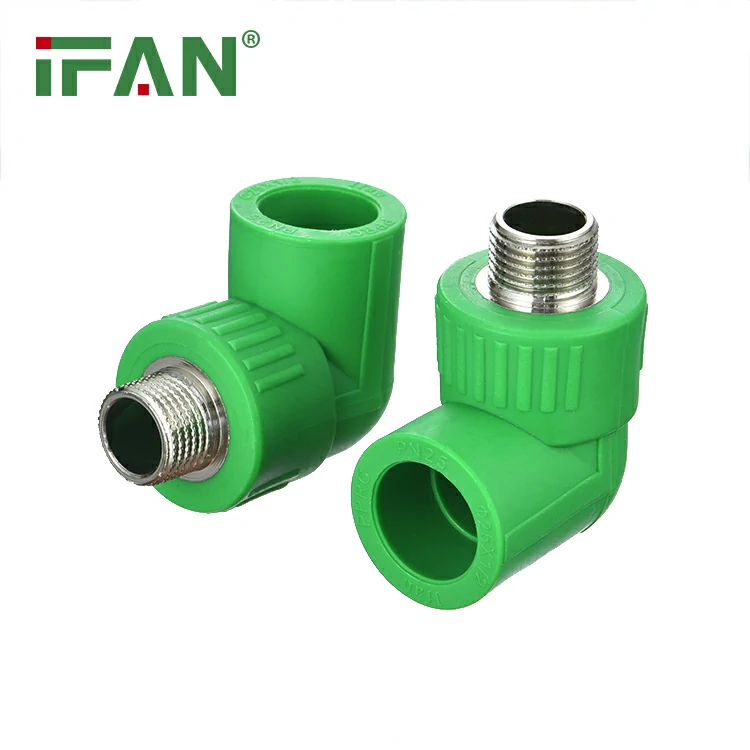
A PPR tube fitting male elbow is a L-shaped or angled connector with external threading on one end and a smooth socket on the other. It joins two PPR pipes or fittings at a right (90°) or acute (45°) angle while providing a secure, threaded connection to female-threaded components like valves, unions, or other elbows.Key Features:
Material: Made from PPR Type 3, a heat-resistant polymer with 3–5% ethylene for enhanced impact strength.
Temperature Range: Operates from -10°C to 95°C (14°F to 203°F), suitable for both hot and cold water systems.
Pressure Rating: Withstands up to 25 bar (362 PSI) when installed correctly.
Thread Standard: Compatible with ISO 228 (parallel threads) or BSPT (tapered threads), depending on region.
Common Applications:
Redirecting water flow in kitchen/bathroom plumbing.
Connecting PPR pipes to threaded appliances (e.g., water heaters, faucets).
Navigating obstacles in tight spaces without excessive pipe bending.
Types of PPR Tube Fitting Male Elbows
1. 90° PPR Male Elbow
Purpose: Creates a sharp 90° turn in piping systems.
Design:
One end features external threads (male) for female fittings.
The other end has a smooth socket for socket fusion with PPR pipes.
Advantages:
Minimizes pressure loss in vertical/horizontal pipe transitions.
Ideal for wall-mounted fixtures like showers or sinks.
2. 45° PPR Male Elbow
Purpose: Provides a gentler 45° angle for smoother flow redirection.
Design:
Similar threaded/socketed structure as the 90° variant but with a reduced angle.
Advantages:
Reduces turbulence and noise in water flow.
Suitable for horizontal pipe runs under floors or in ceilings.
3. Reducing PPR Male Elbow
Purpose: Connects PPR pipes of different diameters at an angle.
Design:
One end has a larger socket for a bigger pipe, while the other end features a smaller male thread.
Advantages:
Eliminates the need for separate reducers and elbows.
Useful for retrofitting old plumbing with modern PPR systems.
4. Composite PPR Male Elbow (with Metal Insert)
Purpose: Enhances thread durability in high-pressure industrial systems.
Design:
A brass or stainless-steel threaded insert is molded into the PPR elbow.
Advantages:
Prevents thread stripping under repeated tightening.
Recommended for chemical transport or compressed air lines.
Advantages of PPR Tube Fitting Male Elbows
1. Corrosion Resistance
Unlike metal elbows, PPR variants do not rust or degrade when exposed to water, chlorine, or acidic chemicals, ensuring long-term reliability.
2. Thermal Stability
Withstands temperatures up to 95°C without warping, making them suitable for hot water recirculation systems.
3. Lightweight and Easy to Install
Weighs 60% less than brass or steel elbows, reducing labor fatigue during installation.
4. Leak-Proof Design
The socket fusion joint creates a homogeneous bond with PPR pipes, while threaded connections are sealed with Teflon tape or thread sealant.
5. Cost-Effective
30–40% cheaper than metal alternatives and requires no soldering or welding tools.
How to Install a PPR Tube Fitting Male Elbow
Step-by-Step Guide
Cut the Pipes: Use a PPR pipe cutter to create square, burr-free ends.
Mark Insertion Depth: Use the elbow’s depth gauge to avoid over-insertion.
Heat the Socket and Pipe:
Use a PPR welding machine to heat the elbow’s socket and the pipe end to 260°C (500°F).
Fuse the Joint: Insert the pipe into the socket within 5 seconds of heating and hold for 10–15 seconds to cool.
Thread the Female Connection:
Wrap Teflon tape clockwise around the male threads.
Hand-tighten the elbow into the female fitting (e.g., valve or union).
Use a wrench to tighten an additional 1–2 turns (avoid over-tightening).
Test for Leaks: Turn on the water supply and inspect the joint for drips.
Common Mistakes to Avoid
Uneven Heating: Overheating can deform the socket, while underheating leads to weak joints.
Cross-Threading: Align threads carefully to prevent damage.
Insufficient Cooling Time: Moving the pipe before cooling causes misalignment.
Applications of PPR Tube Fitting Male Elbows
Residential Plumbing: Connecting PPR pipes to sinks, showers, or water heaters at angles.
Commercial Buildings: Routing pipes around structural beams in HVAC systems.
Industrial Systems: Transporting chemicals or compressed air with minimal pressure loss.
Agriculture: Directing irrigation pipes around obstacles in fields.
IFAN factory started in 1993. And IFAN has workshop 120000 square meter with 610 staff. IFAN can design and produce all plumbing pipe and fitting include PPR,PVC,CPVC PPSU HDPE PEXA PEXB PERT pipe and fitting ,brass fitting, brass ball valve ,heating system , gas system , sanitary faucets and hose, In the past 30 Years, IFAN has never forgotten his mission-To protect health and safety. And IFAN factory use best materials to produce high quality pipe and fittings with automatic production line and high tech quality control machines. The most important,IFAN can guarantee that all pipes and fittings manufactured by IFAN are qualified. More information pls feel free contact us Whatsapp.



 PPR
PPR