PPR Tube Fitting Male Socket: Design, Installation, and Advantages
Description
Introduction
PPR tube fitting male socket critical components in plumbing systems, enabling secure, leak-proof connections between PPR pipes and threaded fixtures like valves, taps, or pumps. Known for their corrosion resistance, high-temperature tolerance, and ease of installation, male sockets eliminate the need for additional adapters, streamlining pipeline assemblies. This guide covers their design, applications, installation methods, and advantages, helping you choose the right fittings for your project.
What Is a PPR Tube Fitting Male Socket?
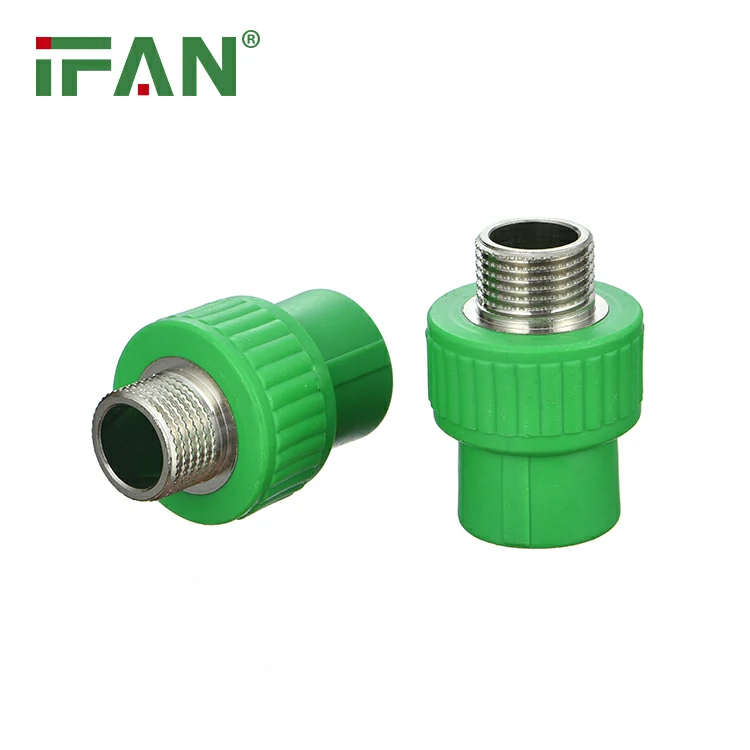
A PPR tube fitting male socket is a cylindrical connector with external threads on one end and a socketed cavity on the other. The socketed end fuses with PPR pipes via heat welding, while the threaded end screws into female-threaded components (e.g., valves, meters, or tanks).Key Features:
Material: Made from PPR Type 3, which contains 3–5% ethylene for enhanced impact resistance.
Temperature Range: Operates from -10°C to 95°C (14°F to 203°F), suitable for hot/cold water systems.
Pressure Rating: Withstands up to 25 bar (362 PSI) when installed correctly.
Common Applications:
Connecting PPR pipes to water heaters, boilers, or storage tanks.
Integrating PPR systems with threaded metal valves in industrial settings.
Retrofitting old plumbing networks with modern PPR pipes.
Types of PPR Tube Fitting Male Sockets
1. Standard Male Socket
Purpose: General-purpose connection between PPR pipes and female-threaded fixtures.
Design:
Straight body with uniform threading (e.g., BSPT, NPT).
Available in sizes from 20mm to 110mm.
Advantages:
Versatile for residential and commercial plumbing.
Cost-effective compared to multi-part adapters.
2. Reducing Male Socket
Purpose: Joins PPR pipes of different diameters to threaded fixtures.
Design:
Larger socket end for the main pipe (e.g., 50mm) and smaller threaded end (e.g., 25mm).
Advantages:
Simplifies pipeline transitions without needing multiple fittings.
Reduces material costs in large-scale projects.
3. Electrofusion Male Socket
Purpose: Quick installation in field repairs or tight spaces.
Design:
Embedded heating coils around the socketed end.
Requires an electrofusion machine for activation.
How It Works:
Clean the pipe and socket surfaces.
Insert the pipe into the socket.
Connect the machine and apply 40V AC for 1–3 minutes.
Let the joint cool for 30 minutes.
Advantages:
No heavy tools needed.
Ideal for emergency pipe repairs.
4. Threaded Male Socket with O-Ring
Purpose: Enhances leak resistance in high-pressure systems.
Design:
Rubber O-ring seated in a groove near the threads.
Creates a secondary seal when screwed into female fittings.
Advantages:
Reduces the risk of thread-related leaks.
Suitable for chemical transport pipelines.
Advantages of PPR Tube Fitting Male Sockets
1. Single-Piece Construction
Eliminates joints between the socket and threaded section, reducing potential leak points.
2. Corrosion Resistance
Unlike metal fittings, PPR male sockets do not rust when exposed to water or chemicals, ensuring long-term reliability.
3. Lightweight and Easy to Handle
Weighs 60% less than brass or steel fittings, lowering shipping costs and installation fatigue.
4. Cost-Effective
30% cheaper than brass male adapters and requires fewer tools for installation.
5. Environmentally Friendly
100% recyclable and produced with 25% less energy than metal alternatives.
How to Install a PPR Tube Fitting Male Socket
Step-by-Step Guide for Socket Fusion
Cut the Pipe: Use a pipe cutter for a square, debris-free edge.
Mark Depth: Use the socket’s depth gauge to avoid over-insertion.
Heat Surfaces: Place the pipe and socket in a fusion machine at 260°C for 5–10 seconds.
Join Under Pressure: Quickly insert the pipe into the socket and hold for 10–15 seconds.
Cool Naturally: Let the joint solidify for 2 minutes before handling.
Step-by-Step Guide for Threaded Connection
Wrap Threads: Use PTFE tape (3–4 wraps clockwise) or thread sealant on the male end.
Hand-Tighten: Screw the male socket into the female fitting until snug.
Wrench Finish: Tighten an additional 1–2 turns with a wrench (avoid over-tightening).
Common Mistakes to Avoid
Cross-Threading: Align threads carefully to prevent damage.
Insufficient Sealant: Leaks occur if threads are left bare.
Overheating: Burning the PPR during fusion weakens the joint.
Applications of PPR Tube Fitting Male Sockets
Residential Plumbing: Connecting PPR pipes to taps, water heaters, or washing machines.
Commercial Buildings: Linking pipelines to fire sprinklers or HVAC systems.
Industrial Systems: Transporting chemicals or compressed air in factories.
Agriculture: Routing irrigation pipes to pumps or fertilizer tanks.
IFAN factory started in 1993. And IFAN has workshop 120000 square meter with 610 staff. IFAN can design and produce all plumbing pipe and fitting include PPR,PVC,CPVC PPSU HDPE PEXA PEXB PERT pipe and fitting ,brass fitting, brass ball valve ,heating system , gas system , sanitary faucets and hose, In the past 30 Years, IFAN has never forgotten his mission-To protect health and safety. And IFAN factory use best materials to produce high quality pipe and fittings with automatic production line and high tech quality control machines. The most important,IFAN can guarantee that all pipes and fittings manufactured by IFAN are qualified. More information pls feel free contact us Whatsapp.




 PPR
PPR