PPR Tube Fitting Tee: Types, Installation, and Applications for Efficient Plumbing Systems
Description
Introduction
PPR tube fitting tee essential components in modern plumbing, designed to split or redirect water flow in residential, commercial, and industrial systems. Known for their durability, heat resistance, and leak-proof joints, PPR tees outperform traditional metal fittings by resisting corrosion, scaling, and chemical degradation. This guide explores the types, installation techniques, advantages, and applications of PPR tube fitting tees, helping you make informed decisions for your plumbing projects.
What Is a PPR Tube Fitting Tee?
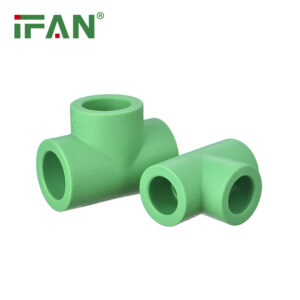
A PPR tube fitting tee is a T-shaped connector made from polypropylene random copolymer, a thermoplastic material engineered to withstand high temperatures (up to 95°C/203°F) and pressures (up to 25 bar/362 PSI). It features three openings: one inlet and two outlets (or vice versa), enabling efficient flow distribution.Key Features:
Heat Fusion Compatibility: Joins seamlessly with PPR pipes via socket or electrofusion.
Chemical Resistance: Unaffected by acids, alkalis, or chlorine, making it safe for potable water.
Smooth Interior: Reduces friction and prevents sediment buildup.
Lightweight Design: 50% lighter than metal tees, easing handling and installation.
Common Applications:
Residential hot/cold water supply lines.
Underfloor heating systems.
Industrial chemical transport.
HVAC and compressed air networks.
Types of PPR Tube Fitting Tees
1. Standard Straight Tee
Purpose: Splits flow into two parallel directions (e.g., branching a main line into two sub-lines).
Purpose: Connects pipes of different diameters (e.g., 32mm main line → 25mm + 20mm branches).
Design:
One inlet and two outlets with varying sizes.
Prevents pressure drops in mismatched pipelines.
Advantages:
Versatile for retrofit projects.
Minimizes the need for multiple adapters.
3. Socket Fusion Tee
Purpose: Permanent joints for small-to-medium diameter pipes (20–110mm).
Design:
Molded sockets for heat fusion welding.
Requires a socket fusion machine for installation.
How It Works:
Heat the tee socket and pipe ends to 260°C.
Insert the pipes into the sockets and hold for 10–15 seconds.
Cool naturally for 2 minutes before pressurizing.
Advantages:
Leak-proof, homogeneous joints.
Suitable for buried or above-ground systems.
4. Electrofusion Tee
Purpose: Quick installation in tight spaces or field repairs.
Design:
Embedded heating coils for precise fusion.
Requires an electrofusion machine.
How It Works:
Clean the pipe and tee surfaces.
Wrap the electrofusion tape around the pipes.
Connect the machine and apply 40V AC for 1–3 minutes.
Let the joint cool for 30 minutes.
Advantages:
No heavy machinery needed.
Ideal for emergency repairs.
5. Compression Tee
Purpose: Temporary or reusable joints without welding.
Design:
Rubber gaskets and stainless-steel clamps for a tight seal.
Screw-on outlets for easy disassembly.
Advantages:
No heat or special tools required.
Suitable for low-pressure systems (e.g., irrigation).
Limitations:
Lower pressure ratings (up to 16 bar/232 PSI).
Not recommended for buried pipelines.
Advantages of PPR Tube Fitting Tees
1. High-Temperature Resistance
Withstands continuous use at 95°C (203°F), making it ideal for hot water lines.
2. Corrosion and Scale-Free
Unlike metal tees, PPR does not rust or accumulate limescale, ensuring consistent flow rates.
3. Leak-Proof Joints
Heat fusion creates a single, homogeneous piece, eliminating gaps where bacteria or contaminants could enter.
4. Cost-Effective
40% cheaper than copper tees and 30% lighter than steel, reducing material and labor costs.
5. Eco-Friendly
100% recyclable and produced with 20% less energy than metal alternatives.
How to Install a PPR Tube Fitting Tee
Step-by-Step Guide for Socket Fusion
Cut Pipes Squarely: Use a pipe cutter for clean edges.
Mark Insertion Depth: Use the tee’s depth gauge to avoid over-insertion.
Heat Surfaces: Place the tee socket and pipe ends in a socket fusion machine at 260°C for 5–10 seconds.
Join Under Pressure: Quickly insert the pipes into the sockets and hold for 10–15 seconds.
Cool Naturally: Avoid disturbing the joint for 2 minutes.
Step-by-Step Guide for Electrofusion
Clean Surfaces: Remove dirt and moisture with alcohol wipes.
Position Tee: Align the electrofusion tee onto the pipes.
Apply Current: Connect the machine and run for 1–3 minutes.
Cool: Let the joint solidify for 30 minutes before testing.
Common Mistakes to Avoid
Overheating: Burning the PPR weakens the joint.
Undercooling: Moving the tee too soon causes leaks.
Dirty Surfaces: Dust prevents proper fusion.
Applications of PPR Tube Fitting Tees
Residential Plumbing: Splitting hot/cold water lines in kitchens and bathrooms.
Commercial Buildings: Distributing water in hotels, hospitals, and schools.
Industrial Systems: Transporting chemicals or compressed air in factories.
Agriculture: Branching irrigation lines for crop watering.
IFAN factory started in 1993. And IFAN has workshop 120000 square meter with 610 staff. IFAN can design and produce all plumbing pipe and fitting include PPR,PVC,CPVC PPSU HDPE PEXA PEXB PERT pipe and fitting ,brass fitting, brass ball valve ,heating system , gas system , sanitary faucets and hose, In the past 30 Years, IFAN has never forgotten his mission-To protect health and safety. And IFAN factory use best materials to produce high quality pipe and fittings with automatic production line and high tech quality control machines. The most important,IFAN can guarantee that all pipes and fittings manufactured by IFAN are qualified. More information pls feel free contact us Whatsapp.



 PPR
PPR